
To understand Seiko merely as a mass-market Japanese watch brand is to miss much of what the company has contributed to modern horology. Seiko has built almost every category of watch, from affordable daily mechanical watches to Olympic timing equipment, the world’s first commercial quartz wristwatch, high-beat mechanical movements, Spring Drive, Kinetic, solar watches, GPS Solar technology, and Grand Seiko as a high-end independent luxury marque. If Swiss watchmaking built much of its prestige around tradition, heritage, and craft, Seiko built a parallel language of watchmaking around accuracy, durability, manufacturing control, materials science, practicality, and industrial refinement.
Grand Seiko is the most concentrated expression of that ambition. The brand does not rely primarily on loud symbols or exaggerated luxury cues. Its philosophy is simpler and more demanding: a watch should be accurate, legible, durable, beautifully finished, and able to interact with light in a way that rewards close attention. The appeal of Grand Seiko rarely announces itself all at once. It reveals itself slowly through the texture of the dial, the sharp planes of the hands, the mirror-polished case surfaces, the motion of the seconds hand, the feel of the crown, the alignment of the date window, and the comfort of the case on the wrist. This article explains Seiko and Grand Seiko through technology and heritage, and why Grand Seiko now deserves to be viewed as a distinct standard in high-end watchmaking rather than merely an alternative to Swiss luxury brands.
1. Seiko’s Origins: From Watch Retailer to Manufacturer
Seiko’s story began in 1881, when Kintaro Hattori opened a watch and clock repair shop in Ginza, Tokyo. Japan was rapidly modernizing, and accurate timekeeping was becoming essential for railways, communications, finance, education, and industrial coordination. Hattori did not want Japan to remain dependent on imported watches. He believed that Japan needed the ability to manufacture accurate timepieces domestically. In 1892 he established the Seikosha factory, first producing wall clocks and later expanding into pocket watches and wristwatches.
This early manufacturing base matters because Seiko did not grow merely as a distributor or brand name. It became a vertically integrated producer. Over time, Seiko sought to control as many processes as possible, including cases, dials, hands, movements, hairsprings, lubrication, assembly, adjustment, and inspection. That internal control later became critical in the quartz revolution and in the development of Grand Seiko’s high-precision mechanical watches. Accuracy in watchmaking is not achieved by design alone. It depends on repeatable metalworking, tight tolerances, stable oils, shock resistance, temperature behavior, and the skill of final adjustment. Seiko built its identity by learning to manage that entire chain.
2. Grand Seiko in 1960: An Internal Goal of Being the Best
Grand Seiko was launched in 1960. By then Seiko was already Japan’s leading watchmaker, but the symbolic center of high-grade mechanical watchmaking still belonged to Switzerland. The goal behind Grand Seiko was clear: not simply to make a good Japanese watch, but to build one of the most accurate and finely made wristwatches in the world. The first Grand Seiko used the caliber 3180 and achieved a level of precision that was exceptional for its period. The design was restrained, but that restraint was not a lack of ambition. It reflected a focus on essence.
What makes early Grand Seiko interesting is that it did not simply copy Swiss luxury codes. Seiko tried to combine Japanese aesthetics with industrial precision. Instead of excessive decoration, Grand Seiko emphasized clear indexes, highly legible hands, balanced case proportions, sharp reflective surfaces, and a design language built for daily reliability rather than social display. Grand Seiko luxury is less about the price tag others can recognize and more about the quality the wearer experiences every day. That philosophy has remained central to the brand for decades.
3. The 44GS and the Grammar of Design
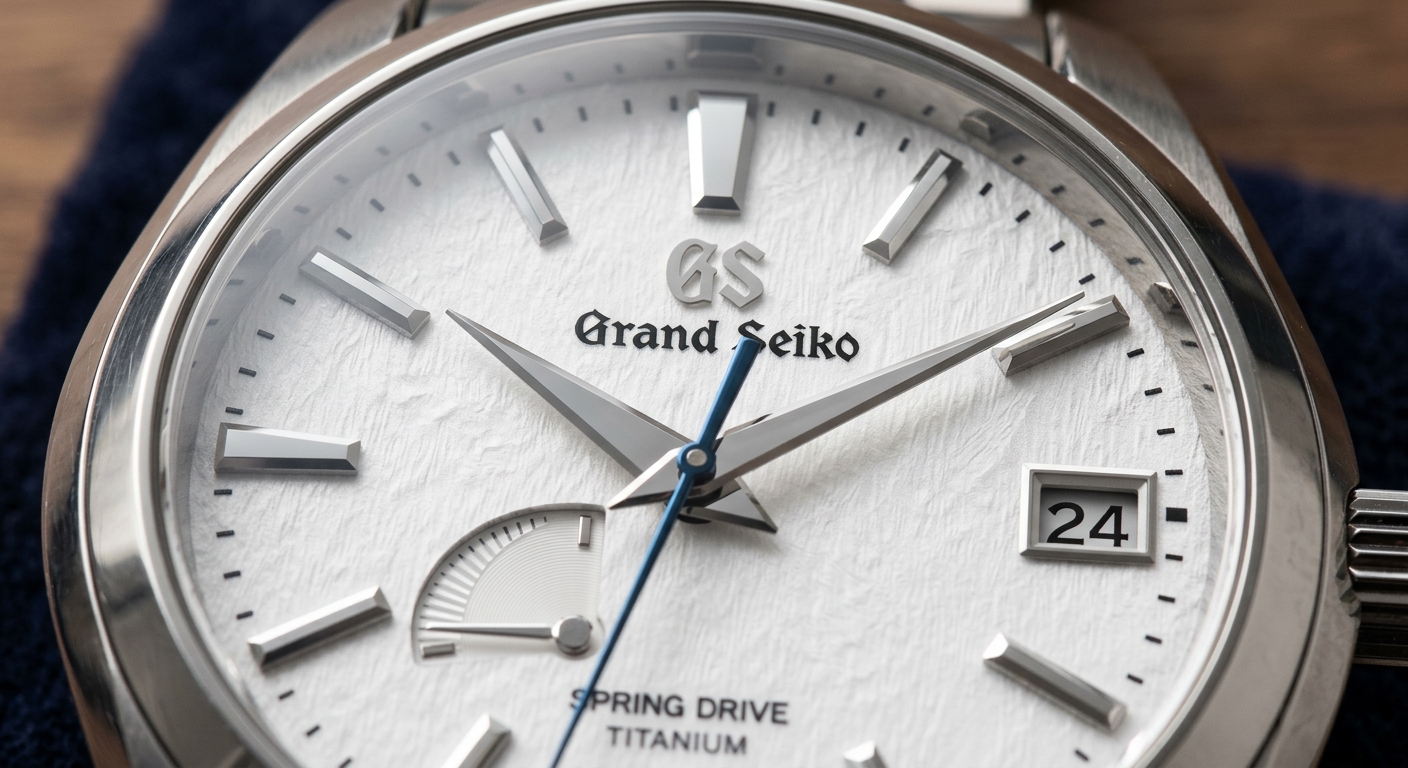
The 44GS, introduced in 1967, established the decisive design language of Grand Seiko. Often called the “Grand Seiko Style” or the “Grammar of Design,” this was not a nostalgic exercise. It was a coherent system of wide flat case planes, distortion-free mirror polishing, sharp edges, multi-faceted indexes, blade-like hands, strong legibility, and carefully controlled dial space. The design favors the contrast of light and shadow over soft decorative curves. As a result, Grand Seiko watches often appear more complex in real life than in photographs.
A Grand Seiko case is designed around planes and angles. As the wrist moves, the case side, bezel, lugs, indexes, and hands catch light from different directions. Surfaces brighten and darken instantly. This is not simple shine; it is structural reflection. Where many Swiss high-end watches create depth through brushing, polishing, and beveling, Grand Seiko often uses broader planes and sharper edges to create a sense of tension reminiscent of Japanese architecture or a polished blade. This is one of the most important aesthetic differences between Grand Seiko and other luxury watches.
4. Zaratsu Polishing: A Distortion-Free Mirror by Hand
No discussion of Grand Seiko is complete without Zaratsu polishing. The term is often linked to a German polishing machine, but the name matters less than the result. Ordinary polishing can make metal bright, but if the surface is slightly distorted, the reflected image becomes soft and wavy. Grand Seiko’s Zaratsu technique aims for a flat, mirror-like surface that reflects without visible distortion. Craftspeople use the front surface of a rotating polishing wheel, controlling the angle, pressure, time, and direction of contact with extreme care.
This is difficult to automate. Each surface of the case requires a different touch. Too much polishing rounds the edges; too little fails to produce the required reflection. The strength of Grand Seiko is not simply that its cases are shiny. It is that the case lines remain crisp after polishing. In luxury watches, the sharpness of an edge matters. A softened edge makes a watch look less precise and less expensive. A sharp edge makes even a small case feel solid and refined. Zaratsu polishing is the physical expression of Grand Seiko’s claim that it designs with light.
5. Mechanical Movements: A Relentless Pursuit of Accuracy
Seiko’s mechanical watch history is not a story of revival alone. In the 1960s, Seiko competed seriously in Swiss observatory chronometer trials and developed deep knowledge of high-precision movement design. It improved component production, regulation, lubrication, frequency management, and balance design. Modern Grand Seiko mechanical movements stand on that foundation. The 9S family, for example, aims to balance reliability, accuracy, durability, and serviceability for everyday use.
Mechanical accuracy is the result of many interacting factors. The balance wheel must oscillate consistently. The hairspring must remain stable across temperatures and positions. The gear train must minimize energy loss. The movement must recover from shock. The amplitude difference between a fully wound mainspring and a nearly depleted one must be controlled. Grand Seiko addresses these issues through MEMS microfabrication for escapement components, improved alloys, careful regulation, and longer power reserves. Although the exterior may appear traditional, the inside contains a great deal of modern manufacturing technology.
6. Hi-Beat 36,000: The Advantages and Burdens of High Frequency
Grand Seiko’s Hi-Beat movements are a strong statement of technical confidence. Many modern mechanical watches operate at 28,800 vibrations per hour, while Grand Seiko’s Hi-Beat 36,000 movements operate at 36,000 vibrations per hour, or ten beats per second. A higher frequency can help average out disturbances from position changes and external shock. It also gives the seconds hand a smoother visual motion and can support higher accuracy.
Yet high frequency is not an easy solution. More beats mean more friction, more wear, greater demands on lubrication, and higher energy consumption. To make a high-beat movement reliable, a manufacturer needs precise component production, excellent oils, efficient gear design, and adequate power reserve. Grand Seiko continues to develop Hi-Beat movements because they fit the brand’s philosophy of accuracy. A Hi-Beat Grand Seiko gives the wearer the vitality of a traditional mechanical movement while maintaining a composed, disciplined character.
7. Spring Drive: A Hybrid Innovation Only Seiko Could Build
If one technology defines the originality of Grand Seiko, Spring Drive may be the strongest candidate. Spring Drive is not a quartz watch driven by a battery-powered motor, and it is not a traditional mechanical watch regulated by an escapement. Its power comes from a mainspring, just as in a mechanical watch. The wearer winds the crown or the rotor winds the mainspring, and stored energy travels through a gear train. The difference lies in regulation. Instead of a conventional escapement, Spring Drive uses a glide wheel, integrated circuit, quartz oscillator, and electromagnetic brake in what Seiko calls the Tri-synchro Regulator.
The result is visually and technically distinctive. The seconds hand does not tick in small steps. It glides almost continuously around the dial. This is not merely a smooth visual effect. It expresses the philosophy of Spring Drive. Natural time does not move in chopped intervals; it flows. Grand Seiko turns that flow into a visible experience on the wrist. At the same time, Spring Drive offers quartz-level accuracy. Where ordinary mechanical watches are often judged by daily deviation, Spring Drive approaches monthly deviation. For someone who wants mechanical energy and electronic precision in the same watch, Spring Drive is difficult to replace.
8. The Tri-synchro Regulator: Coordinating Three Forms of Energy
The core of Spring Drive is the Tri-synchro Regulator. As the name suggests, it manages three kinds of energy. The first is mechanical energy from the mainspring. The second is electrical energy generated by the rotation of the glide wheel. The third is electromagnetic energy used for braking and speed control. The system does not require a battery. A tiny generator creates electricity, the integrated circuit compares time against a quartz reference, and the electromagnetic brake adjusts the speed of the glide wheel.
Technically, Spring Drive challenges the usual categories of watchmaking. Some traditional mechanical enthusiasts hesitate because it contains electronic components. A better interpretation is that Spring Drive is a modern rethinking of mechanical power. The wearer still winds a mainspring, feels the rotor, and owns a watch whose energy moves through gears. Only the final regulation stage uses quartz reference and electromagnetic control. Such a combination was possible because Seiko had deep experience in both mechanical and quartz watchmaking. Few companies had the manufacturing knowledge to integrate these worlds convincingly.
9. The Quartz Revolution and 9F: The World of High-End Quartz
No account of Seiko’s technology can ignore quartz. In 1969, the Seiko Astron became the world’s first commercial quartz wristwatch and changed the structure of the watch industry. Quartz watches were vastly more accurate than mechanical watches, more resistant to shock, and easier to produce at scale. The revolution shook Swiss watchmaking and made Seiko a symbol of technological disruption. But as quartz became affordable and widespread, it also gained an unfair reputation as a cheap technology. Grand Seiko’s 9F quartz movement refutes that idea.
The 9F movement is not ordinary quartz. It includes temperature compensation, a high-torque motor, backlash auto-adjustment, precise date switching, a sealed structure that helps preserve lubrication, and high annual accuracy. The high-torque motor matters because Grand Seiko uses large, polished, substantial hands. Many quartz watches use thin lightweight hands to conserve energy, but 9F allows Grand Seiko to maintain its signature legibility and visual presence. The seconds hand also lands cleanly on the markers, creating a sense of mechanical discipline. Anyone who dismisses quartz as inherently low-end should experience a 9F Grand Seiko before making that judgment.
10. Dial Technology: Expressing Nature Through Structure
Grand Seiko’s dials have played a major role in the brand’s global recognition. Snowflake, White Birch, Omiwatari, Mt. Iwate, Sakura, and seasonal Shinshu-inspired dials are not simple color exercises. Grand Seiko expresses Japanese natural textures through physical structure on metal. Snow fields, birch bark, frozen lake surfaces, mountain ridges, and seasonal light are translated through stamping, coating, plating, cutting, lacquering, and finishing.
These dials are often designed to change under different light rather than to look loud in a single photograph. Indoors, a dial may appear quiet and silver. Under natural light, texture emerges. At another angle, shadows deepen. Grand Seiko dials convert Japanese restraint and seasonal awareness into modern watch manufacturing. The wearer does not see exactly the same surface every time. The dial responds to time of day and environment. This material pleasure is something a digital display or mass-produced accessory cannot easily provide.
11. Hands and Indexes: High Finishing in Service of Legibility
The hands and indexes of a Grand Seiko are small components, but they are among the fastest ways to judge the brand’s quality. Indexes are not simple metal bars. They are sharply cut, multi-faceted components designed to catch light. The hands also use broad planes and crisp edges so the time can be read quickly on both light and dark dials. In many luxury watches, legibility is sacrificed for design. Grand Seiko treats legibility as part of luxury.
This is a practical view of high-end watchmaking. A watch is ultimately a device for reading time. No matter how expensive a watch is, if it is difficult to read, its essential quality is compromised. Grand Seiko carefully controls index height, hand length, the distance between the minute hand and minute track, the date window position, and the density of dial text. These details do not shout from across a room, but they matter to the person wearing the watch every day. In a business environment, being able to read the time with a slight turn of the wrist is part of Grand Seiko’s quiet form of luxury.
12. Materials and Durability: From Bright Titanium to Ever-Brilliant Steel
Seiko and Grand Seiko have also experimented extensively with materials. Bright titanium is lighter than stainless steel, highly corrosion-resistant, and comfortable for long wear. Titanium has clear advantages, but it is harder to process and polish, and it can look dull or gray if not finished properly. Grand Seiko works to give titanium the same sense of polish and refinement found in steel models through a combination of Zaratsu polishing and brushing. Its lightness can be especially attractive for people sensitive to wrist fatigue or metal weight.
Ever-Brilliant Steel emphasizes corrosion resistance and a bright white tone. Compared with common 316L stainless steel, it offers a cleaner and more luminous impression while helping maintain surface quality over time. Grand Seiko’s approach to materials is rarely flashy. Rather than using exotic materials only for visual drama, it emphasizes long-term stability, comfort, and finishing quality. This is another reason the brand feels closer to a precision instrument than a fashion accessory.
13. Seiko Prospex and the Diver’s Watch Heritage
Seiko’s technical heritage is not limited to Grand Seiko. The Prospex diver’s watch line shows how strong Seiko has been in practical tool watches. Since Japan’s first diver’s watch in 1965, Seiko has developed professional diving watches with strong water resistance, saturation diving capability, shock resistance, reliable bezel design, legibility, luminous performance, and robust sealing. Seiko divers are widely respected by collectors as real tool watches, not merely style objects.
This experience also informs Grand Seiko’s sports models. Grand Seiko sports watches are often thicker and more assertive than the dress models, but they benefit from Seiko’s long experience with durability and water resistance. Many brands enter the luxury sports watch market with an image of sportiness. Seiko has actually built professional-use watches for decades. That background gives Grand Seiko’s sport-oriented models a stronger technical foundation.
14. Production Philosophy: Studios and Craftspeople
Grand Seiko is produced through specialized facilities and studios in Japan. Spring Drive and 9F quartz are closely associated with the Shinshu region, while mechanical movements are strongly connected with the Shizukuishi Watch Studio in Iwate. This regional distinction is not only marketing. It reflects specialization in movement assembly, regulation, finishing, inspection, and craft knowledge.
Grand Seiko craftsmanship differs from the Swiss tradition of decorative Geneva stripes and elaborate anglage. It focuses more on functional refinement, assembly accuracy, exterior finishing, and the visual quality of dials and hands. In other words, Grand Seiko often invests its effort in the areas the wearer sees every day and in the performance factors that directly affect the watch. Some high-end models also feature beautiful movement finishing, but the core of the brand remains practical precision rather than decorative excess.
15. How Grand Seiko Differs from Swiss Brands
Grand Seiko is often compared with Rolex, Omega, Jaeger-LeCoultre, IWC, Breguet, Patek Philippe, and other Swiss names. But it is inaccurate to see Grand Seiko simply as a cheaper alternative to Switzerland. Swiss brands have strengths in historical prestige, global distribution, secondary-market liquidity, cultural symbolism, sponsorship, and traditional complications. Grand Seiko’s strengths are different: finishing relative to price, proprietary technology, accuracy, dial execution, Japanese design philosophy, and quiet distinctiveness.
If Rolex represents brand power, robustness, and market liquidity, Grand Seiko may offer more satisfaction to an enthusiast who studies the object closely. If Omega emphasizes history and technical certification, Grand Seiko takes a different route through Spring Drive, Zaratsu polishing, and 9F quartz. It does not pursue the ultra-high-complication artistry of Patek Philippe or Vacheron Constantin, but within its price range, its exterior finishing and accuracy are unusually compelling.
16. The Heritage Collection: Continuity of Principles
The Grand Seiko Heritage Collection may be the clearest expression of the brand’s identity. Modern interpretations of historical designs such as the 44GS, 62GS, and 57GS are not merely retro exercises. They preserve principles: wide flat surfaces, sharp lugs, open dials, clean cases, blade-like hands, and faceted indexes, all combined with modern movements. These watches work with formal clothing and casual wear, and they tend to age well because the design language is restrained.
The Heritage Collection matters because it shows that Grand Seiko is not a trend-driven brand. Watch fashion repeatedly moves through colors, case sizes, integrated bracelets, vintage lume, and nostalgic proportions. Grand Seiko responds to the market, but its core collection remains consistent in proportion and finishing. That consistency gives long-term owners confidence. The brand’s visual language does not shift dramatically every few years.
17. Evolution 9: The Direction of Modern Grand Seiko
The Evolution 9 design language shows how Grand Seiko is modernizing while preserving its identity. It retains the broad surfaces and strong light play of classic Grand Seiko design, while improving center of gravity, lug width, bracelet balance, hand and index boldness, and modern case proportions. It reflects what global buyers increasingly demand: better ergonomics, stronger wrist presence, and more versatile sportiness.
Evolution 9 models often pair this design with advanced Spring Drive movements, five-day power reserves, or high-performance Hi-Beat calibers. Older Grand Seiko models could feel conservative and dress-oriented. Evolution 9 aims at a wider lifestyle without losing the brand’s restraint. The watches are modern, but they do not rely on oversized logos or decorative noise. That balance is the point.
18. Investment and Secondary Value: Expectations vs. Reality
Grand Seiko has long been considered undervalued relative to its product quality. Global awareness has risen, limited dials have become more collectible, Spring Drive has been reappraised, and the brand’s independent positioning has improved recognition. Still, investors should be realistic. Most watches are not pure financial assets. Except for a limited number of highly liquid models from brands such as Rolex, Patek Philippe, and Audemars Piguet, immediate premiums are not guaranteed. Grand Seiko values vary significantly by model, purchase price, and holding period.
Even so, Grand Seiko remains attractive because its ownership value can be high even when speculative upside is limited. A buyer can obtain exceptional finishing, proprietary technology, high accuracy, and distinctive design for the money. Certain limited editions and popular dials may defend value better than standard models, but the most rational approach is to buy a watch one genuinely wants to wear. Grand Seiko is strongest when viewed as a product and ownership experience, not as a short-term trading instrument.
19. How to Choose a Grand Seiko
A first Grand Seiko should be chosen according to personal priorities. If the buyer values traditional mechanical life, the beat of the seconds hand, and the emotional appeal of a mechanical movement, a 9S mechanical or Hi-Beat model makes sense. If the buyer wants extreme accuracy, a gliding seconds hand, and Seiko’s most distinctive invention, Spring Drive is the symbolic choice. If the buyer wants convenience, annual accuracy, and the peak of high-end quartz, 9F is an excellent option and should not be dismissed.
Case material also matters. Stainless steel provides familiar weight and solidity. Bright titanium offers comfort for long wear. Dials should ideally be seen in person because Grand Seiko surfaces change dramatically with light. Buyers with smaller wrists should check not only diameter but also lug-to-lug length and case thickness. Some Spring Drive models are relatively thick, so wrist fit matters. Bracelet adjustment and clasp design should also be considered, especially for people who are sensitive to fit throughout the day.
20. Grand Seiko Within the Wider Seiko Ecosystem
Grand Seiko plays a symbolic role within the wider Seiko world. Seiko 5 represents accessible mechanical watchmaking. Prospex represents professional tool watches. Presage connects Japanese craft with classic design. Astron represents GPS Solar technology. Grand Seiko gathers these manufacturing traditions and expresses them at the highest level. It is an independent luxury brand, but it is also the most refined expression of Seiko’s long manufacturing philosophy.
That matters for the owner. Buying a Grand Seiko is not merely buying an expensive Japanese watch. It means choosing a product shaped by the quartz revolution, diver’s watch engineering, high-beat mechanical development, Spring Drive, precision exterior finishing, nature-inspired dials, and Japanese restraint. Swiss watch brands often build mythology through royalty, aviation, diving, motorsport, or exploration. Seiko and Grand Seiko build their mythology through industrialization, accuracy, practicality, engineering persistence, and the observation of nature.
21. Conclusion: Grand Seiko Is Quiet but Powerful Luxury
The value of Grand Seiko does not come mainly from a large logo or instant social recognition. Its strengths are quieter. They become clear when the wearer studies the dial, sees how the case reflects light, watches the seconds hand move, experiences the accuracy, and observes how the finishing holds up over years of use. Grand Seiko is less a watch for impressing people who know little about watches and more a watch for convincing the wearer and knowledgeable enthusiasts.
Seiko’s history proves that accessibility and luxury, mechanical and electronic technology, industrial production and hand craft, practicality and aesthetics can coexist. Grand Seiko is the most refined form of that coexistence. Spring Drive expresses the flow of time through technology. 9F proves that quartz can be genuinely high-end. Hi-Beat mechanical movements extend traditional horology. Zaratsu polishing and dial craftsmanship turn light and nature into metal. For these reasons, Grand Seiko should not be seen merely as a substitute for Swiss watchmaking. It is an independent Japanese standard of precision luxury.