
Summary
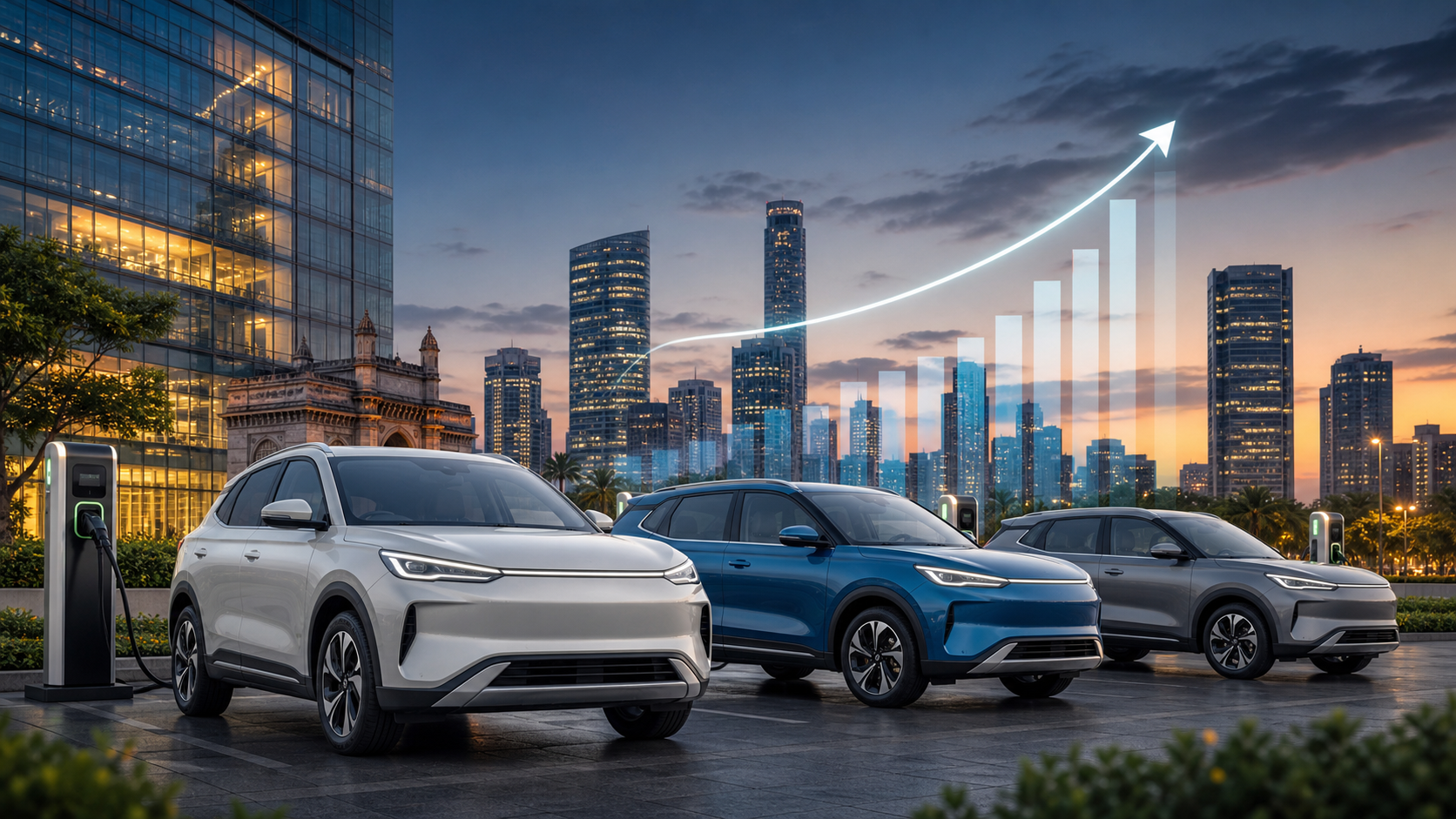
- India EV sales crossed 30,000 electric cars and SUVs in June 2026 for the first time, lifting the market above the weak-growth narrative that dominated parts of 2024 and 2025.
- The rebound looks more like a product-cycle inflection than a pure subsidy event, with Tata, Mahindra, and MG all contributing to a broader competitive market.
- For investors, the more immediate opportunities may sit in electric SUV platforms, charging infrastructure, power electronics, battery packs, and localized low-cost supply chains.
(Advertisement)
Introduction: Why India EV Sales Matter Again
India EV sales have long represented one of the global auto industry’s most attractive but most frustrating opportunities. The country has the scale of a top-three global car market, a large urban middle class, policy support for electrification, and severe air-quality incentives to reduce oil dependence. Yet electric passenger vehicles have remained a small share of the market. Two-wheelers and three-wheelers electrified first, while electric cars and SUVs were held back by price, charging access, limited model choice, and consumer concerns about resale value.
That is why June 2026 matters. Public industry reports indicate that India’s electric car and SUV sales crossed 30,000 units in a single month for the first time. The same reporting ecosystem showed electric passenger vehicle sales of roughly 18,000 units in January 2026, implying that the monthly run-rate moved sharply higher in only five months. A single month does not prove a structural transition, but it does show that India’s electric passenger vehicle market is no longer driven only by early adopters or a narrow set of low-cost models.
The question for investors is not whether India will become another China overnight. It will not. The better question is whether the Indian EV market has reached the point where automakers, suppliers, dealers, charging operators, and financiers can treat electric vehicles as a repeatable business line rather than a policy-dependent experiment. June’s data suggests that the answer is increasingly yes.
Why It Matters
EV adoption curves are rarely smooth. They tend to move through thresholds: first credible models, first meaningful charging networks, first price parity in selected segments, and then the first months when volume becomes large enough for the ecosystem to invest with confidence. India’s June EV sales figure is one of those thresholds. It is still small in absolute terms, but large enough to change behavior across the value chain.
Main Analysis
1. The Data: A Small Number Globally, a Big Number Locally
Compared with China or Europe, 30,000 electric cars and SUVs in a month is not large. Compared with India’s own history, it is meaningful. Public reports suggest that January 2026 electric passenger vehicle sales were around 18,000 units, while June crossed 30,000. That implies a roughly two-thirds increase in the monthly baseline over five months.
| Metric | Reported figure | Investment interpretation |
|---|---|---|
| January 2026 electric PV sales | About 18,000 units | Strong start to the year from a low penetration base |
| June 2026 electric car and SUV sales | More than 30,000 units | First monthly break above the 30,000-unit threshold |
| Tata Motors CY2025 EV sales | 81,125 units, up 18% YoY | Incumbent EV leader still expanding |
| Q1 FY2027 reports | Tata and Mahindra EV sales doubled YoY | Growth broadening beyond one incumbent |
Chart 1. India Electric Car and SUV Monthly Sales Baseline
18k
30k+
Note: Approximate public reporting figures. The chart is intended to show directional baseline change rather than exact registration-level precision.
The important point is not the exact 30,000-unit line. It is the signal that a higher monthly baseline may be forming. In early-stage EV markets, monthly figures can be distorted by subsidy deadlines, shipment timing, new-model launches, and registration delays. But once a market repeatedly moves above prior ceilings, the supplier ecosystem starts to react. Charging operators become more willing to build capacity, dealers invest in EV-specific training, and financiers become more comfortable with residual value assumptions.
2. The Rebound From a Two-Year-Low Narrative Was Really a Product-Cycle Rebound
The phrase “two-year low” can be misleading if it implies that Indian consumers lost interest in EVs. A more useful interpretation is that demand was constrained by product availability and affordability. Indian consumers are highly value-conscious. They will not pay a large premium for an electric vehicle unless the product clearly works as a substitute for a combustion vehicle in range, space, reliability, service access, and resale value.
The earlier soft patch in the market reflected that gap. The first wave of Indian EV buyers accepted compromises because they valued the technology, operating-cost savings, or early-adopter status. The next wave wants a normal car that happens to be electric. That is a much tougher test. The June rebound indicates that automakers are finally offering more vehicles that pass that test.
3. Tata Is Defending, Mahindra Is Attacking
Tata Motors built India’s early electric passenger vehicle market. Its advantage came from fast execution, accessible pricing, brand trust, and a group ecosystem that could support charging and energy services. Public reporting that Tata sold 81,125 EVs in CY2025, up 18% year-on-year, confirms that the incumbent remains highly relevant.
But the market is no longer only about Tata. Mahindra’s BE 6 and XEV 9e have changed the conversation because they bring EVs into the heart of India’s SUV demand pool. In India, SUVs are not just a body style. They reflect road conditions, family usage, social signaling, and resale confidence. If electric SUVs become credible replacements for combustion SUVs, the addressable market expands materially.
| Company | Current role | What matters for investors | Main risk |
|---|---|---|---|
| Tata Motors | Incumbent EV leader | Broad portfolio, accessible pricing, ecosystem support | Share pressure from Mahindra and MG, margin dilution |
| Mahindra & Mahindra | Electric SUV challenger | Dedicated EV platforms, SUV brand equity, launch momentum | Production ramp, quality stability, durability of early demand |
| JSW MG Motor India | EV mix expander | Urban EV positioning and rising electric share of sales | Brand scale, pricing pressure, service network depth |
| BYD, Hyundai, others | Premium and selective players | Technology credibility and global platforms | Pricing, localization, limited volume reach |
4. This Looks Less Like a Subsidy Spike and More Like a Model-Cycle Inflection
Subsidies matter in every EV market. They can pull demand forward, improve affordability, and reduce buyer hesitation. But subsidies alone rarely create sustainable 30,000-unit monthly demand in passenger vehicles. Buyers still need products that fit their lives. India’s June rebound looks more connected to the arrival of better electric SUVs and broader model choice than to a one-off policy effect.
This distinction matters. Subsidy-led rallies often fade when policy changes. Product-led adoption can compound. As more credible models enter the market, each automaker is forced to improve range, charging speed, interiors, software, and pricing. That competitive pressure is what makes the market investable.
5. The Supply Chain Winner May Not Be the Cell Maker First
Investors often map any EV sales rebound directly to battery cell demand. That is directionally correct but incomplete in India. The country’s cell manufacturing base is still developing, and much of the near-term value may accrue to pack assembly, battery management systems, thermal management, onboard chargers, DC fast chargers, connectors, wiring harnesses, and power electronics.
India’s EV market also favors affordability. That points toward LFP chemistry, localized assembly, simplified electronics, software-enabled cost reduction, and platform reuse. The highest-quality investment opportunities may therefore be suppliers that can localize reliably at low cost rather than companies with the most advanced premium technology.
Investment Implications
Winner 1: Automakers With Electric SUV Platforms
The most direct beneficiaries are automakers with credible electric SUV platforms. Tata has incumbency, while Mahindra has launch momentum. Investors should not look only at unit sales. They should track order backlog, production capacity, battery procurement cost, warranty provisions, and EV gross margin. Volume without margin discipline can still disappoint equity holders.
Winner 2: Charging Infrastructure and Grid Equipment
If India EV sales remain above prior monthly ceilings, charging infrastructure becomes a capital cycle. Apartment charging, workplace charging, highway charging, retail-destination charging, and fleet depots all become more relevant. Utilization may be weak at first, but cumulative vehicle parc is the key variable. Once the installed EV base compounds, operating leverage can improve.
Winner 3: Localized Power Electronics and Low-Cost Components
The Indian market will reward cost control. Suppliers of battery packs, BMS, thermal systems, chargers, inverters, converters, connectors, and vehicle software should benefit if they can meet automotive reliability standards at Indian price points. Global investors should watch both listed auto suppliers and private-market charging infrastructure players.
Risk: Do Not Overread One Month
June was strong, but monthly data can mislead. Seasonality, launch timing, channel inventory, financing conditions, and registration delays can all distort the picture. The right confirmation window is the next three to six months. A durable trend would show not only high sales but also stable market share, manageable discounts, and improving delivery times.
Conclusion: India EV Sales Have Crossed an Important Threshold, Not the Finish Line
India EV sales crossing 30,000 electric cars and SUVs in June 2026 is a significant milestone. It suggests that the market is moving beyond an early-adopter phase and into a more competitive product-led phase. Tata remains the incumbent leader, Mahindra is emerging as a serious electric SUV challenger, and MG plus global players are widening consumer choice.
The investment conclusion is constructive but disciplined. India’s EV opportunity is real, but it is still early. Charging infrastructure, battery supply, affordability, quality, and resale values remain open questions. The most attractive exposure is likely to come from companies that can combine local cost structures with credible electric platforms or components. In that sense, June’s rebound is not the end of the story. It is the point at which India’s EV market becomes too important for global auto and supply-chain investors to ignore.
Related Topics
- India’s electric SUV competition
- Tata Motors versus Mahindra in EVs
- LFP batteries and emerging-market EV adoption
- Charging infrastructure and grid investment
Sources
- Autocar Professional, “Electric Car and SUV Sales Cross 30,000 for the First Time in June,” 2026-07-01.
- Autocar India, “June 2026 EV sales: total monthly sales cross 30,000 units for the first time,” 2026-07-01.
- Autocar India, “Tata and Mahindra EV sales double YoY in Q1 FY2027,” 2026-07-02.
- Autocar Professional, “Tata EV Registers Highest Monthly and Quarterly Dispatches in June and Q1 FY2027,” 2026-07-02.
- Autocar Professional, “Tata Motors Sells 578,771 Cars and SUVs in CY2025, EV Sales up 18% at 81,125 Units,” 2026-01-03.