
Summary
- Christopher Nolan’s The Odyssey looks like a gigantic mythic adventure, but its most haunting question is intimate: how much of the self is fixed, and how much is remade by distance, danger, love, exile, and time?
- Odysseus risks his life to return home because home is not merely a location. It is memory, obligation, recognition, grief, pride, and the place where a person hopes his name still means something.
- For anyone living away from a home city, especially nomads and expatriates, The Odyssey becomes less like an ancient story and more like a mirror. Home may be inherited, chosen, or built, but the harder question is whether some part of us remains constant through all of those changes.
(Advertisement)
After watching The Odyssey, the strange thing is that the first image to linger is not the sea. The waves are there, of course. So are the battles, the gods, the monsters, the fire, the scale, the roar of a movie built for the biggest screen available. Yet what stays behind is smaller and more human: a man trying to go home.
That sounds simple until the film begins to press on it. Why would anyone risk so much for home? Why not accept survival, power, pleasure, or a new identity somewhere else? Why keep moving toward an old place when the journey itself may destroy you? The Odyssey is thrilling because it is enormous, but it is moving because it asks a question that has followed human beings for thousands of years: are we the people we were born as, or the people the world has made us become?
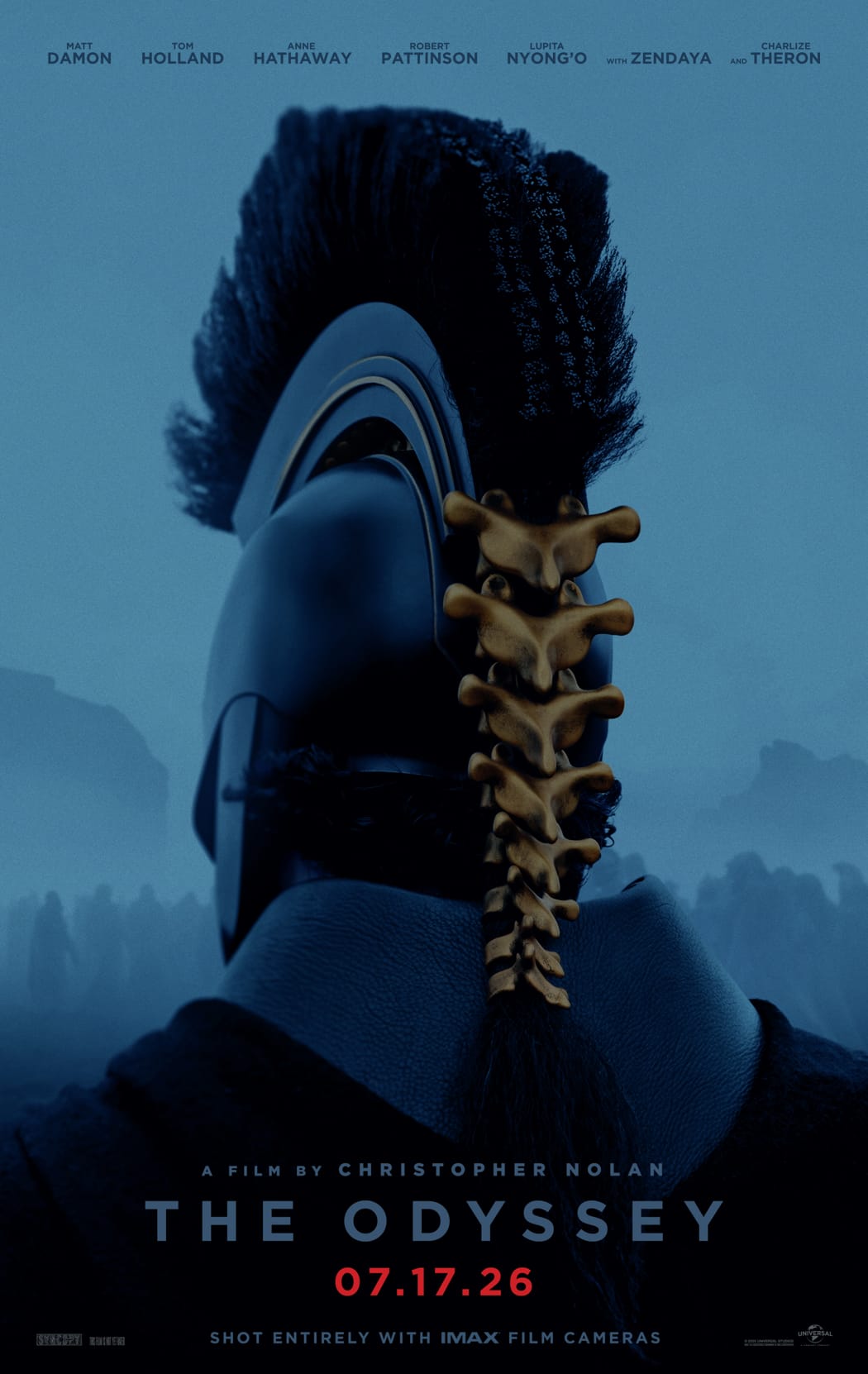
The official site describes Nolan’s film as a mythic action epic based on Homer’s foundational saga, shot across the world with new IMAX film technology. That description is accurate. The Odyssey is a large film in the literal sense. But the best large films do not merely become bigger than life. They make private life feel bigger. Here, the private question is identity. What remains of a person after war, travel, temptation, loss, homesickness, and time have done their work?

Why Does Odysseus Need Home So Badly?
Odysseus’s desire to return home is both noble and slightly unreasonable. If home simply meant a bed, a familiar meal, and a piece of land, the obsession would feel excessive. But in The Odyssey, home is much more than comfort. Home is the world that remembers who you were before the world changed you.
That is why home can be both warm and frightening. A stranger may know your new accomplishments, your better clothes, your changed accent, your more polished version of yourself. Home remembers something more inconvenient. Home remembers the beginning. It remembers your earlier name, your family role, your embarrassing habits, your unedited voice. It remembers you before you learned how to perform adulthood.
Odysseus is not merely trying to reach Ithaca. He is trying to reach the fact that he was once Odysseus before the journey scattered him. Yet that creates the film’s most painful tension. Can a person really return to the self he used to be? Or does the act of returning reveal that the old self is gone?
Is Identity Inherited Or Made?
The film’s richest question is whether identity is discovered or constructed. We often talk about personality as if it were a stone hidden inside us. “I am just that kind of person.” “I have always been this way.” “This is where I come from.” There is comfort in that idea. It suggests that under all the noise of life there is a stable core, a private Ithaca, waiting for us.
But experience keeps interfering. We are changed by work, by cities, by languages, by heartbreak, by ambition, by illness, by money, by loneliness, by the ordinary repetition of days. A person who spends five years in another country does not simply acquire new memories. He acquires new instincts. He learns when to speak, how to stand, what to expect, what to fear, what to miss. The environment does not decorate the self. It trains it.
So who is Odysseus? Is he the man before Troy, the survivor at sea, the husband longing for home, the strategist shaped by danger, or the man who finally returns? The answer is probably all of them. The Odyssey does not make identity easy. It suggests that the self has a core, but that the core is covered by layers of experience. The journey does not erase the person. It deposits sediment on top of him.

A Person Who Left A Home City Watching An Ancient Journey
The reason this question feels personal is that I am now old enough to say that well over ten years have passed since I left the city I once called home, and part of my life has unfolded somewhere else. That sentence sounds plain, yet it contains a quiet confusion. Having a starting point is not a fact that can be revised. But the years spent elsewhere are also part of me now. So am I still fundamentally the same person I was at the beginning, or have other places rebuilt me?
Anyone who leaves a birthplace lives with at least two clocks. One clock belongs to the present: the city where you work, the streets you now know, the people who text you, the language or tone you use every day. The other clock belongs to the beginning: the smell of the sea, a family nickname, the humidity of a particular season, the sound of a local dialect, the ordinary neighborhood that becomes strangely luminous only after you leave it.
A home city cannot explain everything about me. That would be too easy. But it also cannot be removed from me. A starting place is not a complete identity, but it is a first grammar. Even when you learn new words elsewhere, the early grammar remains underneath. Sometimes you hear it when you are tired. Sometimes you feel it when you meet someone who understands the same kind of beginning. Sometimes you notice it only because you are far away.
Leaving home does not always weaken the idea of home. Sometimes it sharpens it. When you live in your hometown, it is background. When you leave, it becomes a sentence: “I am from that city.” That sentence is not just information. It is a small myth about origin, pride, family, ordinary streets, distance, and memory.
Nomads, Expatriates, And The Modern Problem Of Home
The Odyssey feels unusually contemporary because our age is full of movement. Digital nomads work from one city to another. Students study in foreign languages. Migrants rebuild their lives from the ground up. Professionals move for markets, visas, love, or opportunity. For some people, movement is freedom. For others, it is necessity. For many, it is both.
This is why the word home has become unstable. Home may be inherited: the place where you were born before you had any choice. Home may be chosen: the city where you decide to stay because it fits the adult you are becoming. Home may also be built: a rented apartment, a regular cafe, a few friends, a morning routine, a shelf of books, the small rituals that turn a location into a life.
But building a new home does not delete the old one. It creates a layered identity. There is the home-city self, the present-city self, the London self, the New York self, the Singapore self, the professional self, the family self, the solitary self. These selves may seem inconsistent, but perhaps inconsistency is not the problem. Perhaps the problem is the demand that a person be only one thing.

The Debate Around The Film: Spectacle Or Emotion?
The conversation around Nolan’s The Odyssey has been lively because viewers and critics seem to divide over the same tension. Some reviews celebrate the film as a grand revival of ancient epic in modern cinematic language: IMAX scale, physical spectacle, mythic imagery, and the rare sense that a movie theater is still a place of communal awe. On that level, the film clearly works. It wants to be seen as cinema with weight.
Other critics have been colder. Some argue that the film is so monumental that the emotional life of the story struggles to breathe beneath the architecture. The most interesting objections are not simple complaints about length or seriousness. They ask whether an adaptation of The Odyssey can honor not only heroism, but also waiting, grief, violence, compassion, and the lives of those who are left behind while the hero becomes legendary.
I find the disagreement useful because the story of homecoming should be conflicted. A homecoming can be triumphant, but it is never innocent. The person who returns has survived, but survival has a cost. The person who waited has remained, but remaining also has a cost. If The Odyssey were only a victory march, it would be shallow. If it were only an emotionally empty spectacle, it would not have generated so much argument. Its real power sits in between: it makes the desire for home look majestic, but it also makes that desire morally complicated.
Is Home A Place, A Relationship, Or A Memory?
As we grow older, home stops being one thing. In childhood, home is usually an address. It is where your bed is, where dinner waits, where your belongings are. In adulthood, home becomes more relational. It is where someone recognizes your tired face. It is where you do not have to translate yourself too much. It is where failure does not require a long explanation.
Later still, home becomes memory. Some homes can no longer be entered. The family moved. The neighborhood changed. The store closed. The person you were there no longer exists. Yet you still call it home because home does not live only in the present tense. It also lives in the past tense.
Maybe this is what Odysseus is chasing. He wants Ithaca, but he also wants the world in which Ithaca meant certainty. The cruel wisdom of The Odyssey is that return does not cancel time. Home changes while we are gone. The people we love change. We change. Homecoming is not a return to the past. It is a meeting between a changed person and a changed place.
Why Home Is An Emotional Question
This is also why the film feels larger than a story about travel. Identity is not an abstract luxury. People are steadier when they can tell a coherent story about where they came from, where they are, and where they are going. When that story breaks, even a successful life can feel strangely hollow.
Nomads, expatriates, migrants, and people who leave their hometown for work often know a particular feeling: not fully belonging anywhere. Back home, they may feel changed. In the new place, they may feel not yet rooted. That feeling is not failure. It is one of the psychological costs of movement. Ignored, it can become loneliness. Understood, it can become self-knowledge.
The Odyssey does not offer the easy comfort that one day we arrive at a perfect home and all fragmentation ends. Its comfort is more mature. It suggests that a person can change without dissolving. The birthplace, the places of exile, the chosen cities, the lost friends, the new habits, the old accent, the revised ambition: all of these can coexist inside one life. Identity is not a pure stone. It is a mosaic.
More Than Ten Years Away, And Looking Back At The Starting Point
There is something strange about realizing that well over ten years have passed since leaving a home city. It is too long to describe as a brief departure, but still too unsettled to feel like the whole story has been decided. Earlier choices begin to return as consequences, yet the future remains open enough to be frightening. That is why this stage of life often makes people look backward. Where did I come from? Why did I leave? How much of the person I was has survived?
For someone who left a home city and lived elsewhere, The Odyssey becomes less like a myth and more like a private mirror. We may not have fought monsters, but we have crossed our own seas. The first day lost in an unfamiliar city. The moment we softened or hid an accent. The night a conversation with an old friend felt slightly misaligned. The day we realized our parents were aging faster than our own sense of time. These are not epic events, but they are real voyages.
The hard part is accepting that change is not betrayal. The person shaped by another city is not less authentic. The person from the beginning remains, but so does the person formed elsewhere. A life does not need a single, pure identity to be real. It can be mixed, revised, and still honest.
So Where Is Home?
After The Odyssey, my answer is less simple than before. Home is not only one place, but not every place becomes home. Home is where we repeatedly want to return, or where we cannot return but still feel explained. Home may comfort us. Home may hurt us. Sometimes it does both.
Odysseus moves toward home not because home contains all the answers, but because home contains the right questions. Am I still myself? Is there anything left after what I have lost? Can the people who knew my beginning meet the person I have become? These questions are not trapped in ancient waters. They reach the person living abroad, the student in London, the professional in Singapore, the migrant in New York, the digital nomad who keeps changing countries but secretly wants one room to feel permanent.
In the end, The Odyssey is a film about return, but its deeper subject is the promise a person tries to keep with himself. I have changed, but I have not disappeared. I have left, but I have not entirely forgotten where I began. I have been remade elsewhere, but that remaking is also part of my story. That is a beautiful answer because it is not too neat.
Conclusion
The Odyssey feels, while watching it, like a film of sea, war, myth, and spectacle. Later, it becomes quieter. It leaves behind one question: where does a person want to return, and what does that desire prove?
Odysseus’s homecoming is not merely a journey back to a location. It is an experiment in identity. Did home make him, or is he still making home through memory and choice? For anyone who has been away from a home city for well over ten years, lived between cities, or wondered whether change has carried them too far from their original self, the film offers a generous question. You have changed. But through that change, is there still something that can be called you?
I want to believe the answer is yes. Not because identity is fixed like bloodline or address, but because identity can be tended like a direction. Home can be inherited, chosen, and built. The self can be, too. Where we come from matters. But the places we continue to name as home also matter, because those names are how we keep ourselves from becoming completely lost.
Sources
- Universal Pictures official The Odyssey synopsis
- Universal Pictures official The Odyssey gallery
- Universal Pictures official The Odyssey site
- Review and criticism coverage from Roger Ebert, The Guardian, Variety, Rotten Tomatoes, AP News, The Conversation, and related film blogs
Language versions:
한국어 원문 |
English version