
Summary
- The Saudi East-West Pipeline is damaged, but there is no credible evidence that it is permanently lost. The real uncertainty is whether Saudi Arabia can restore partial flow in days or needs four to six weeks for reliable, high-volume operation.
- A short outage can be absorbed by inventories, redirected cargoes and limited Hormuz shipments. A multi-week outage would remove a key bypass from an oil market already depleted by war, weak product exports and a 507-million-barrel inventory draw.
- This is not automatically a new 1970s-style oil shock. It becomes one if repairs slip, attacks recur, Hormuz remains constrained, and the Red Sea route also becomes unsafe. Duration and security—not the initial blast alone—will determine the economic damage.
Introduction: the pipeline is repairable, but the clock matters
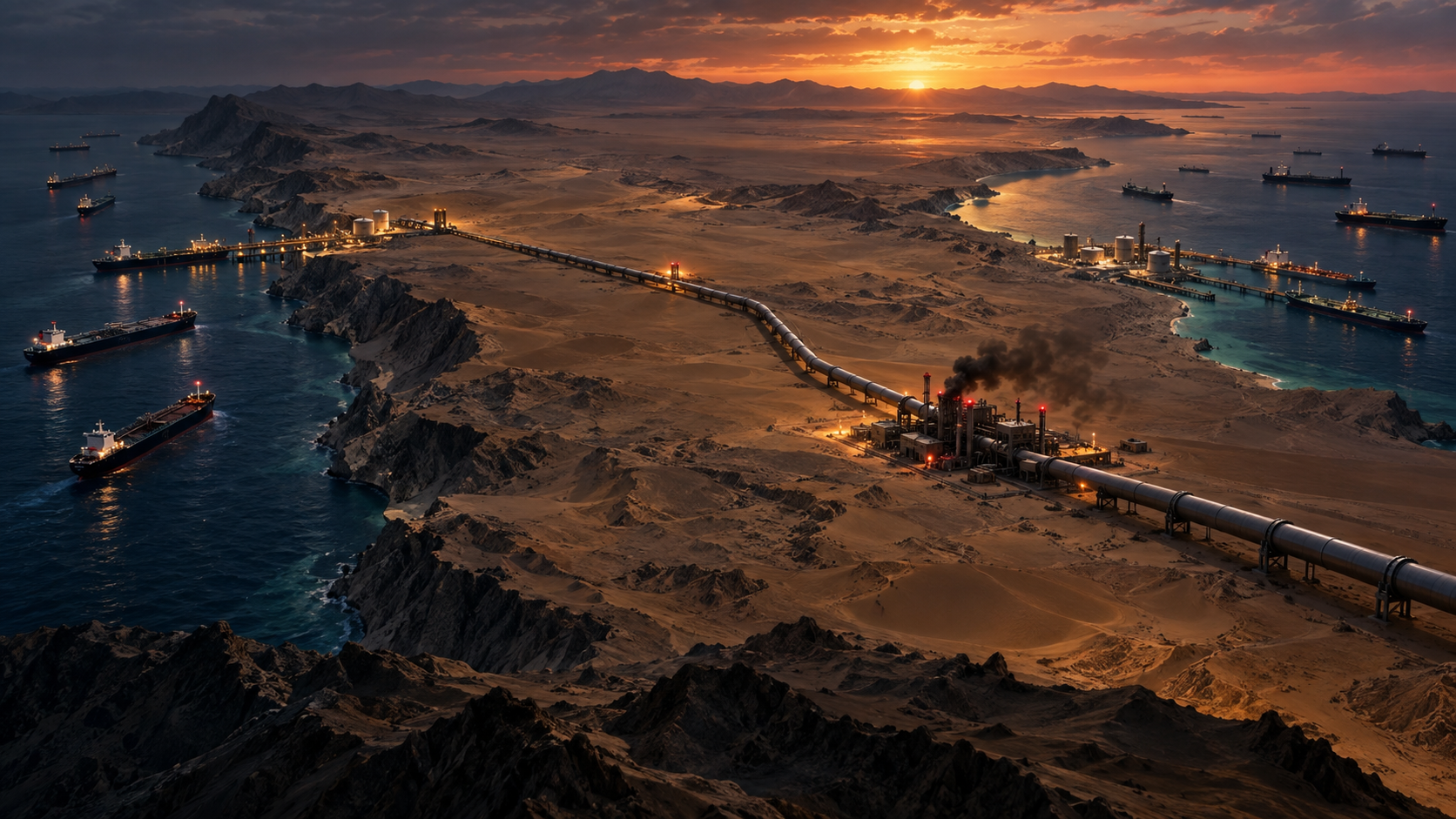
The Saudi East-West Pipeline outage has removed one of the global oil market’s most important emergency routes at exactly the wrong time. The 1,200-kilometre system, also called Petroline, carries crude from the Abqaiq area in eastern Saudi Arabia to the Red Sea port of Yanbu. It allows Saudi exports to avoid the Strait of Hormuz. After drone strikes damaged facilities in the Riyadh and Medina regions, Saudi Arabia shut the line as a precaution while technical teams assessed its safety.[1]
The most useful answer to the immediate question is also the most nuanced: the system is almost certainly repairable, but “repaired” can mean three different things. Saudi Aramco may be able to create a safe temporary flow path or restart an undamaged section within days. Replacing fire-damaged pumps, power systems, valves and controls, testing the line, and restoring dependable full-capacity operation could take weeks. Hardening the facility against another attack could take longer still.
That distinction explains the apparently contradictory forecasts. U.S. Energy Secretary Chris Wright said the interruption should be measured in days and that some Saudi exports are being shifted back through Hormuz with U.S. military support.[4] Satellite analysts and Kpler, however, see extensive damage at a pumping station and estimate four to six weeks for resolution, partly because spare-parts availability and disrupted supply chains matter.[2] Saudi Arabia has not released a detailed engineering assessment. Any precise repair date should therefore be treated as a scenario, not a fact.
The market question is larger than the repair itself. Does this outage mark a new global oil shock, or will inventories and rapid engineering work make it a temporary price spike? The answer depends on the interaction of physical damage, available stocks, shipping security, refinery needs and geopolitics. A pipeline can be fixed. A regional transport system under repeated attack is a harder problem.
Why the Saudi East-West Pipeline matters so much
Petroline was built to turn geography into strategic flexibility. Saudi crude is produced mainly in the east, close to the Persian Gulf. Without the pipeline, large exports normally leave through Gulf terminals and must pass the Strait of Hormuz. In 2024, the strait carried about 20 million barrels a day, roughly 20% of global petroleum-liquids consumption. Saudi crude and condensate accounted for about 5.5 million barrels a day, or 38% of crude flows through the chokepoint.[9]
The East-West system changes that equation by moving crude overland to Yanbu. The U.S. Energy Information Administration describes its normal crude capacity as 5 million barrels a day and notes that Aramco temporarily expanded the system to 7 million barrels a day in 2019 by converting natural-gas-liquids infrastructure.[9] During the 2026 conflict, reported flows varied, but roughly 4 million to 5 million barrels a day were redirected west at times. That is close to 4% of world supply—large enough to matter immediately in a tight market.
| System metric | Why it matters |
|---|---|
| Length: about 1,200 km | A long network can have segment redundancy, but remote pump stations and power systems are exposed targets. |
| Base capacity: about 5 million b/d | This is the most frequently cited sustainable bypass capacity. |
| Expanded design capacity: up to 7 million b/d | Maximum design capacity does not equal dependable export capacity; pump availability, terminal capacity and security also bind. |
| Recent at-risk flows: roughly 3.6–4.5 million b/d | This range equals about 3.5%–4.5% of global demand and is too large for spare production elsewhere to replace quickly. |
| Yanbu inventory cushion: roughly 5–7 days | Exports can continue briefly even when the pipeline stops, which delays the visible effect on tanker loadings. |
The distinction between capacity and exports is critical. A pipeline may be rated for 7 million barrels a day, but the export chain also requires stored crude, functioning tanks, metering systems, port berths, available tankers and a safe Red Sea route. Before the latest attack, Yanbu rarely loaded the system’s theoretical maximum. The outage therefore does not remove 7 million barrels a day from the market. A more credible near-term estimate is that 3 million to 4 million barrels a day of export flexibility is at risk, depending on how much can be rerouted through Hormuz and drawn from storage.[12]
What was damaged—and is the damage permanent?
The publicly available evidence points to severe damage at a pumping station rather than destruction of the entire 1,200-kilometre line. Vantor satellite imagery published by the BBC and CNBC shows blackened ground, burned structures and a large fire-affected area around one station.[2][3] The Saudi Energy Ministry said emergency and specialised technical teams secured the pipeline and began a safety assessment after multiple attacks caused injuries and infrastructure damage.[1]
That evidence does not support the word “permanent.” Crude pipelines are industrial systems designed with isolation valves, replaceable mechanical equipment and operating procedures for damaged sections. Steel pipe can be cut out and replaced. Pumps, motors, transformers, switchgear, instrumentation and control systems can also be replaced. Aramco has deep engineering capacity and demonstrated rapid emergency execution after the 2019 Abqaiq and Khurais attacks, when parts of production returned within 24–48 hours even though full restoration required more time and imported equipment.[17]
However, physical repair is not the same as safe recommissioning. A pumping station concentrates high-pressure machinery, electrical systems, fire protection, communications and remote-control equipment. After a major fire, engineers must determine whether heat damaged structural supports, pressure vessels, seals or nearby pipe. They must isolate the affected segment, verify line integrity, restore electricity and controls, test emergency shutdown systems, and then increase flow gradually. If a critical pump or transformer requires a specialised component not held in Saudi inventory, procurement can become the longest step.
Why “days” and “weeks” can both be correct
| Milestone | Possible timing | What it would mean |
|---|---|---|
| Emergency isolation and safety inspection | Hours to several days | Confirms whether undamaged sections can be used without creating another fire or spill. |
| Partial or temporary restart | Several days, if redundancy exists | A lower flow may bypass damaged equipment or use fewer pumps. This could validate the U.S. energy secretary’s optimistic forecast without implying full repair. |
| Reliable high-volume service | Two to six weeks | Damaged machinery and controls are replaced, tested and ramped. This is consistent with Kpler and other technical estimates. |
| Full resilience and hardening | Weeks to months | Capacity is restored with spare equipment, physical protection, air defence and revised operating procedures. |
There is one more reason for the forecast gap: officials may be describing expected flow resumption, while engineering analysts are describing complete restoration. The market should watch verified barrels, not adjectives. Tanker loadings at Yanbu, pipeline pressure or flow disclosures, and consistent satellite evidence of repair activity will matter more than a general promise that the line will return “soon.”
Three scenarios for the oil market
Scenario 1: partial restart within a week
This is the benign case. Yanbu’s five-to-seven-day stock cushion bridges the outage, Egyptian storage supports some customer deliveries, and Saudi Arabia sends additional cargoes through Hormuz under military escort. The physical loss remains limited, Brent’s risk premium falls, and the curve may soften once westbound pumping is confirmed. Prices would probably not return immediately to pre-war levels because Hormuz and the Red Sea remain dangerous, but the pipeline-specific premium could unwind quickly.
Scenario 2: four-to-six-week disruption
This is the central risk case based on current independent assessments. Rystad estimates that a one-month Yanbu outage could remove roughly 78 million to 120 million barrels of export availability.[12] Commercial inventories, delayed cargoes and emergency stocks can bridge part of that gap, but replacement barrels must travel farther. More U.S., Canadian, Brazilian and West African crude would move toward Asia, while Europe would compete for North Sea, Mediterranean and Atlantic barrels.
The problem is timing as much as volume. A refinery cannot instantly replace medium-sour Saudi crude with any barrel offered on the spot market. Crude quality affects refinery yields, sulphur handling and product output. Atlantic cargoes can take six to eight weeks to arrive in Asia. Tankers remain occupied for longer voyages, reducing effective vessel availability and raising freight rates. The result would likely be steeper backwardation, stronger Dubai and sour-crude differentials, and higher diesel margins.
Scenario 3: multi-month outage or repeated attacks
This is the genuine oil-shock scenario. A two-month outage could place 156 million to 240 million barrels at risk; a three-month disruption could threaten 230 million to 360 million barrels, according to Rystad’s ranges.[12] By then, normal trade reallocation would be insufficient. Asian refiners would draw inventories, cut runs or accept less suitable crude. Strategic stock releases would become essential but would reduce the buffer against the next attack.
The worst case is not simply “the pipeline remains broken.” It is a system-wide security failure: renewed strikes on repaired pump stations, unsafe tanker passage through Hormuz, Houthi control or attack capability near Bab el-Mandeb, and damage to Yanbu storage or loading facilities. In that environment, every alternative route becomes fragile at the same time.
Has a new oil shock arrived?
The world is already experiencing an energy shock, but it is too early to say the East-West Pipeline attack has created a new, self-sustaining 1970s-style oil crisis. The International Energy Agency’s September report shows that the market was under severe stress before this outage: Gulf oil exports in August were around 13 million barrels a day, roughly half their pre-war level; global observed inventories had fallen by 507 million barrels since the war began; and August alone recorded a 95-million-barrel draw.[8] Brent was near $105 a barrel, while diesel prices had risen even more sharply.
Those numbers mean the pipeline attack is a shock multiplier. In a well-supplied market with high inventories, a damaged pump station would cause a temporary regional dislocation. In today’s market, it removes a route that was specifically absorbing the Hormuz disruption. The safety valve failed while the main valve was already partly closed.
Still, a durable oil shock requires persistence. The 1970s episodes combined large supply losses with long policy adjustment, high energy intensity, wage-price feedback and weakly anchored inflation expectations. Today’s economies use less oil per unit of output, strategic reserves exist, and monetary policy frameworks are more credible. The Dallas Fed estimated earlier in 2026 that a one-quarter, 15% global oil shortfall could add about 0.6 percentage point to fourth-quarter-over-fourth-quarter U.S. headline PCE inflation and 0.2 point to core inflation; a three-quarter closure could lift those effects to 1.1 and 0.3 points, respectively.[14] Duration changes the result materially.
The most defensible conclusion is therefore conditional: if partial flow returns within days, this is a violent but reversible price spike; if high-volume operation remains unavailable for a month while Hormuz and Bab el-Mandeb stay constrained, it becomes a second leg of the 2026 oil shock; if attacks continue for several months, the world faces demand destruction and stagflation risk.
Eight factors that will decide whether the crisis fades or escalates
- The exact component damage. Burned auxiliary equipment can be replaced faster than custom high-capacity pumps, transformers or control systems. Damage to the pipe itself may be simpler than damage to a complex pump station.
- Redundancy and partial-flow options. If Aramco can isolate the damaged train and run parallel equipment at lower pressure, exports may resume well before full repair.
- Spare parts and secure logistics. Kpler’s four-to-six-week estimate explicitly cites spare-parts availability and impaired supply chains.[2] Air-freighting components helps only if replacements are immediately available.
- The risk of another strike. A technically successful repair is economically meaningless if crews cannot work safely or the same station is attacked again. Physical protection and air defence are now part of the repair schedule.
- Yanbu and overseas inventories. Stocks at Yanbu provide roughly five to seven days of export cover, and Saudi-held barrels in Egypt add another short buffer.[7] Inventory buys time but cannot replace continuing pipeline flow.
- Hormuz transit capacity. U.S. escorts and a political shipping arrangement could allow Saudi Arabia to redirect barrels east. Continued attacks, insurance restrictions or Iranian controls would close that escape route.
- Bab el-Mandeb security. The Red Sea outlet is valuable only if tankers can leave it safely. A simultaneous Hormuz and Bab el-Mandeb disruption would place routes carrying roughly one-quarter of global oil supply under stress, according to the EIA-based estimate cited by the Council on Foreign Relations.[16]
- Global stocks and policy response. Emergency inventories remain substantial, but they are lower after 2026 releases. EIA estimated Saudi strategic stocks at 74 million barrels and South Korean stocks at 69 million barrels in the second quarter, while U.S. and Japanese reserves had also declined.[10] Governments can smooth a temporary disruption; they cannot indefinitely replace a multi-million-barrel daily route.
Economic and inflation consequences
The first-round effect is visible in gasoline, diesel, jet fuel and petrochemicals. The second-round effect runs through freight, agriculture, manufacturing and household expectations. Diesel deserves special attention because it powers trucking, construction, mining and parts of agriculture. The IEA reports that Gulf and Russian net diesel exports in August were 1.6 million barrels a day below February levels, even before the latest pipeline damage.[8] A crude-only analysis understates the stress.
Central banks face an uncomfortable trade-off. Higher energy prices lift headline inflation and can leak into core services through transport and input costs. At the same time, they reduce consumers’ real income and weaken growth. ECB research finds that oil-supply geopolitical shocks have a much larger financial impact than geopolitical events that do not disrupt energy: equity prices fall, volatility and corporate spreads rise, and industrial production contracts with a lag.[15]
Bond markets may initially push yields higher because investors expect more inflation and delayed rate cuts. If the shock persists and recession risk dominates, safe-haven demand can later pull risk-free yields down even as credit spreads widen. That sequence explains why “oil up” does not produce one mechanical bond-market response. The balance between inflation and demand destruction changes over time.
Why Asia and South Korea are especially exposed
Asia is the centre of vulnerability. EIA estimated that 84% of crude and condensate moving through Hormuz in 2024 went to Asian markets. China, India, Japan and South Korea together received 69% of total Hormuz crude and condensate flows.[9] The region therefore faces both physical supply risk and a freight disadvantage when replacement Atlantic barrels travel around Africa.
For South Korea, the transmission channel is broader than the petrol pump. A higher oil bill can weaken the trade balance and the won, which makes imported energy still more expensive in local currency. Refiners can benefit from stronger product cracks if they secure crude, but margins can reverse if feedstock becomes unavailable or domestic price controls tighten. Airlines, chemicals, logistics and power-intensive manufacturers face higher costs. The country’s strategic stocks provide time, not insulation from a prolonged regional disruption.
Market and investment implications
Upstream producers outside the affected region are the clearest relative winners if prices remain above $100. North American, Brazilian, Guyanese, Canadian and West African exporters gain pricing power and strategic relevance. The largest beneficiaries are producers with available barrels and access to export infrastructure, not merely long-dated resources.
Refiners are split. Complex refiners with flexible crude slates and secure supply can capture exceptional diesel and jet-fuel margins. Less complex Asian refiners may suffer because substitute barrels are expensive, arrive late or produce the wrong product mix. Company-level logistics and configuration matter more than regional labels.
Tanker owners and insurers can benefit from longer voyages and higher rates, but exposure to war-risk zones raises operating and insurance costs. A rerouting boom is profitable only while vessels, crews and coverage remain available.
Airlines, chemicals, transport and consumer businesses are the most direct losers. Hedging can delay the earnings impact but cannot eliminate a prolonged rise in fuel and feedstock costs. Emerging-market importers with weak currencies are particularly vulnerable.
Oil futures themselves require caution. A confirmed partial restart could remove a large risk premium in hours. Conversely, a second strike or empty Yanbu storage tanks could create a gap higher. The distribution of outcomes is unusually wide, making position size and optionality more important than a single-point price forecast.
What investors should monitor next
- Saudi or Aramco confirmation of partial flow, measured in barrels per day rather than broad statements.
- Yanbu tanker loadings and inventory estimates after the five-to-seven-day cushion expires.
- Satellite evidence of new equipment, construction activity and restored power at the damaged station.
- Dubai crude backwardation, medium-sour differentials, diesel cracks and tanker rates.
- Saudi exports through Hormuz under U.S. escort and the cost of war-risk insurance.
- Houthi activity near Bab el-Mandeb and any threat to Yanbu or Red Sea terminals.
- IEA or national announcements on additional strategic-stock releases.
- Whether the forward curve falls after operational news. A declining prompt premium would indicate the market believes supply is returning.
Conclusion: a repairable asset inside a harder security problem
The Saudi East-West Pipeline is not permanently destroyed. Available evidence indicates concentrated damage at a pumping station, an engineering problem that Saudi Aramco has the capability to repair. The optimistic case—partial flow within days—is plausible if the line has usable redundancy and replacement equipment is ready. The four-to-six-week estimate is more credible for dependable high-volume operation because fire damage, specialised components, testing and security all take time.
The larger risk is that repair does not restore the function the pipeline was built to provide. Petroline is valuable because it bypasses Hormuz. If its Red Sea outlet is threatened, if the same infrastructure is attacked again, or if tankers cannot safely pass Bab el-Mandeb, the world loses not just a pipe but an entire contingency plan.
For now, this should be viewed as a potential second leg of the 2026 oil shock rather than proof of a permanent new regime. A partial restart within a week would favour rapid price normalisation. A month-long disruption would tighten crude quality, freight and product markets even if headline supply appears manageable. A multi-month outage combined with renewed attacks would force refinery cuts, larger reserve releases and demand destruction. The decisive evidence will be physical: verified westbound flow, sustained Yanbu loadings and the absence of further strikes.
Related Topics
- U.S. 30-Year Treasury Yield Above 5%: Inflation, Debt, and the 1970s Risk
- Bessent’s Treasury Buybacks and Long-Bond Yields
Sources
- Rigzone — What Does the Yanbu Outage Mean?, quoting the Saudi Ministry of Energy statement, September 15, 2026.
- BBC Verify — Satellite image reveals major damage that shut crucial Saudi oil pipeline, September 15, 2026.
- CNBC — Satellite images show extent of damage to Saudi Arabia’s oil pipeline, September 14, 2026.
- CNBC — Saudi pipeline closure will last days, U.S. Energy Secretary says, September 15, 2026.
- Reuters — U.S. energy chief says Saudi pipeline should be back within days, September 15, 2026.
- Reuters — Saudi pipeline outage threatens loss of 4% of global oil supply, September 14, 2026.
- The Guardian — Satellite images show damage to major Saudi pipeline, September 14, 2026.
- International Energy Agency — Oil Market Report, September 2026.
- U.S. EIA — Strait of Hormuz remains a critical oil chokepoint, June 16, 2025.
- U.S. EIA — Global Energy Security Data, August 12, 2026.
- Reuters Graphics — How the Strait of Hormuz closure affects global oil supply, March 2026.
- Rystad Energy analysis via Rigzone — outage-duration scenarios for Yanbu, September 15, 2026.
- Al Jazeera — Why Saudi Arabia’s East-West pipeline matters for global oil, September 14, 2026.
- Federal Reserve Bank of Dallas — Implications of the Iran war for U.S. inflation, April 17, 2026.
- European Central Bank — How U.S. financial markets react to geopolitical shocks hitting oil supply, June 2026.
- Council on Foreign Relations — Another Hormuz? The Houthi threat to the Red Sea, updated July 20, 2026.
- CNBC — Saudi Aramco reveals 2019 attack damage and restoration timeline, September 20, 2019.
- U.S. EIA — China, the United States and Japan hold most strategic oil inventories, April 20, 2026.
- CNBC — Oil’s safety net is fraying as Saudi Arabia races to restart a key pipeline, September 15, 2026.
- MarketWatch — Saudi Arabia may be days away from losing export capacity, September 15, 2026.
- The Wall Street Journal — What is Saudi Arabia’s East-West Pipeline?, September 14, 2026.
- Reuters — Alternative routes for Middle East oil and gas amid Hormuz disruption, April 21, 2026.
- Sasakawa Peace Foundation — How the Iran war is reshaping Asia’s energy security, September 7, 2026.
Language versions:
한국어 원문 |
English version