
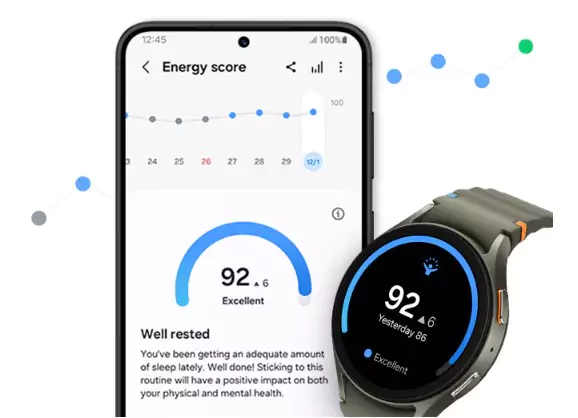
- Samsung Health Energy Score is a Galaxy AI-powered wellness metric that summarizes yesterday’s sleep, activity, sleeping heart rate and heart-rate variability into a simple view of today’s readiness.
- By 2026, Energy Score has become a core part of Samsung’s wearable health ecosystem across Galaxy Watch, Galaxy Watch Ultra, Galaxy Watch8 models, Galaxy Ring and the Samsung Health app.
- The score is not a medical diagnosis. It is best used as a daily planning signal: adjust training, work intensity, sleep timing and recovery based on the trend, not on one isolated number.
Introduction: A smartwatch is now closer to a condition coach than a watch
Samsung Health Energy Score looks simple at first. If the app says 82, you may feel ready. If it says 54, you may start looking for coffee. But the real value of the feature is not the number itself. It is the translation. Energy Score turns sleep duration, sleep regularity, previous-day activity, sleeping heart rate and heart-rate variability into one everyday signal that ordinary users can understand.
Older health apps were mostly logs. They told you how many steps you took, how many calories you burned and how many hours you slept. The problem was interpretation. Six hours and twenty minutes of sleep does not automatically tell you whether you should train hard, schedule difficult work, or blame yesterday’s late dinner for this morning’s fatigue. Samsung Health Energy Score tries to reduce that interpretation burden.
Since 2024, Galaxy AI and Galaxy Watch have made Energy Score one of Samsung’s most visible wearable health features. In 2026, the story has broadened. Galaxy Watch Ultra, Galaxy Watch8 models, Galaxy Ring and Samsung Health now work together as a more complete wellness ecosystem. A watch can capture activity and workouts during the day, while a ring or watch can track sleep and recovery at night. The result is a more continuous picture of how your body responds to everyday life.
This article explains what Samsung Health Energy Score is, what data it uses, what has changed with the latest Galaxy wearable ecosystem, how to interpret the score in real life, and what limitations users must remember. The short version is this: Energy Score is not a judge of your health. It is more like a quiet assistant saying, “today may be a good day to push” or “today may be a day to recover.”
What is Samsung Health Energy Score?
Samsung Health Energy Score is a readiness-style wellness feature. It uses health data from the previous day and night to estimate how prepared your body may be for the current day. Samsung describes it as a general wellness and fitness feature, not as a diagnostic medical tool. A simple way to think about it is this: it estimates how much of your personal battery has been recharged.
The key is combination. Sleeping eight hours does not automatically guarantee a high score. If your bedtime and wake-up time were inconsistent, your sleeping heart rate was elevated, heart-rate variability was weaker than usual, or yesterday’s activity was unusually heavy, the score may still fall. On the other hand, if your sleep was not perfect but your rhythm and recovery markers were stable, the score may be better than expected.
That makes Energy Score different from a pure sleep score. A sleep score focuses mostly on the night. Energy Score connects the night with the previous day’s activity and the current day’s readiness. When you open Samsung Health in the morning, the question is not only “did I sleep well?” It becomes “how should I use my energy today?”
What data does Energy Score use?
Samsung’s public description says Energy Score analyzes personal health metrics including average sleep time, sleep-time consistency, bed and wake-time consistency, sleep timing, previous-day activity, sleeping heart rate and heart-rate variability. The data is tracked by supported Galaxy wearable devices and synchronized with the Samsung Health app.
| Data point | What it means | How to use it |
|---|---|---|
| Average sleep duration | A basic measure of whether you are getting enough sleep | Look for repeated sleep debt, not just one short night. |
| Sleep consistency | Whether your sleep rhythm is regular | Weekend schedule drift can damage Monday readiness. |
| Previous-day activity | The physical load your body carried yesterday | If the score drops after a heavy session, plan recovery. |
| Sleeping heart rate | A sign of how settled your body was overnight | Alcohol, late meals, stress and illness can move it higher. |
| Heart-rate variability | A supporting signal for recovery and autonomic balance | Your personal trend matters more than a single number. |
There is no universal perfect score. A score of 75 can be normal for one person and strong for another. Wearable health data becomes more useful as your personal baseline develops. Instead of reacting intensely to the first few days, users should watch two-week, four-week and eight-week patterns.
What changed by 2026: Galaxy Watch8, Watch Ultra and Galaxy Ring
In 2024, the Energy Score story was mainly about Galaxy AI arriving on Galaxy Watch. By 2026, Samsung’s wearable strategy is broader. The company is positioning health as an ecosystem that includes watches, rings, smartphones and Samsung Health. Samsung’s Galaxy Watch Ultra and Galaxy Watch8 product pages emphasize Galaxy AI-powered health insights, Energy Score, sleep coaching and training metrics.
Galaxy Watch Ultra is built for more demanding activity. For long runs, cycling, swimming, hiking and endurance training, recovery status matters. If Energy Score is low and you continue high-intensity training, you may build fatigue faster than performance. If the score is high and sleep indicators look stable, that may be a better day to push intensity.
Galaxy Ring plays a different role. For users who do not like sleeping with a watch, a ring can be a more comfortable sleep and recovery tracker. Not every feature is identical across devices and markets, but the ring matters strategically because it helps Samsung Health move beyond “daytime activity logging” into overnight recovery tracking. In many wellness routines, the hours spent asleep are more important than the minutes spent exercising.
How to improve your Energy Score in real life
The most realistic ways to improve Energy Score are not exotic. Sleep better, keep a regular schedule, avoid late heavy meals, reduce alcohol, move consistently and manage stress. That sounds ordinary, but ordinary does not mean easy. Most people do not fail because they have never heard of good habits. They fail because they cannot see exactly when and why the pattern breaks. Energy Score is useful because it makes those breaks visible.
The first place to look is bedtime. Total sleep duration matters, but sleep regularity is often just as important. If you sleep at midnight on weekdays and 3 a.m. on weekends, your body may respond as if it is dealing with jet lag. If your score is weak every Monday, your weekend rhythm is a good place to start.
The second factor is late eating and alcohol. Many users notice that a late heavy meal or drinking can reduce the next day’s score even if sleep duration was long. The reason is simple: sleeping is not the same as fully resting. Digestion and alcohol metabolism can raise sleeping heart rate and reduce recovery quality.
The third factor is training load. A low score does not mean you should do nothing. Light walking, stretching and easy movement can help. But high-intensity intervals, long endurance sessions and heavy strength training should be planned with both the score and your actual body feeling in mind. If the score is low and your body feels heavy, that can be a recovery day rather than a failed workout day.
How to interpret a low score
A low Energy Score in the morning can be discouraging. It feels like leaving home with an 18% phone battery. But a low score is not a failure grade. It is a warning light. When a warning light appears on a car dashboard, you do not hate the car. You slow down, check the cause and respond appropriately.
Three questions usually help. Did you sleep too little? Was your sleep schedule irregular? Was yesterday’s activity or stress higher than normal? These questions often reveal the answer. Overtime work, travel, late caffeine, a social dinner, hard training, illness, anxiety and poor sleep timing can all influence the score.
The repeated pattern matters more than one day. Everyone gets a low score sometimes. The more useful signal is a low score that continues for several days, especially if it comes with strong fatigue, headaches, excessive sleepiness or reduced exercise capacity. In that case, lifestyle adjustment comes first. If symptoms are clear or persistent, medical advice is safer than relying on an app.
Energy Score and Samsung’s sleep features
Sleep sits at the center of Energy Score. When Samsung expanded Galaxy AI to Galaxy Watch, it emphasized enhanced sleep algorithms and deeper sleep insights. Movement during sleep, sleep latency, sleeping heart rate and respiratory rate can help explain sleep quality more precisely. These join previously supported indicators such as snoring, blood oxygen and sleep stages.
If you slept seven hours but received a low score, the answer may not be “you need more sleep” only. You may have taken a long time to fall asleep, moved frequently, had an elevated sleeping heart rate, or slept at an unusual time. If you slept six and a half hours but the sleep was stable and your rhythm remained consistent, the score may be more favorable than expected.
Samsung’s sleep apnea-related features also matter, but compatibility must be understood carefully. Samsung support materials indicate that ECG, irregular heart rhythm notifications and sleep apnea features are available only with Samsung phones. By contrast, Samsung Health features such as steps, workouts, heart rate, sleep, stress tracking, blood oxygen, body composition and Energy Score are listed as compatible on Samsung and non-Samsung Android phones. Users should check their exact phone, watch, app version, region and carrier configuration.
Galaxy AI and Wellness Tips: from number to action
A score alone is not enough. If the app says “61,” users still need to know what to do. Samsung addresses that gap with Wellness Tips, which provide insights, motivation and guidance linked to personal health goals. In practice, Energy Score and Wellness Tips should be read together.
If your score is low because sleep consistency collapsed, the best goal may not be a new personal record. It may be restoring bedtime. If the score is low after unusually high activity, the right action may be lighter training, hydration, protein, stretching and early sleep. If the score is high, you may use that day for demanding work, a long workout or an important meeting.
The value of this system is that it turns health management into daily choices. People often make health plans too large: get fit, sleep better, reduce stress, lose weight. Energy Score makes the question smaller: walk for 20 minutes today, skip alcohol tonight, stop caffeine earlier, sleep 30 minutes sooner. Health usually improves through repeated small choices rather than dramatic promises.
Accuracy and limitations: it is a lifestyle signal, not a diagnosis
The most important caution is straightforward: Samsung Health Energy Score is not a medical diagnosis. Samsung describes Energy Score and Wellness Tips as general wellness and fitness features and states that they are not intended for detecting, diagnosing or treating medical conditions. Heart rate, heart-rate variability and sleep data can be useful, but they are not the same as a clinical examination.
Wearable sensors are affected by fit, skin contact, movement, temperature, battery level, wearing time and device model. Rings are also affected by sizing and overnight movement. This is why one day’s score should not control your mood or your decisions. The score is the start of a conversation, not the final answer.
There is also a psychological limitation. Daily health scores can help some people become more consistent, but they can make others anxious. A low score may cause worry; a high score may encourage overtraining. The healthier approach is to treat the number as one interpretation of your body’s signals. Your actual symptoms, energy, mood and performance still matter.
Who benefits most from Energy Score?
Energy Score is especially useful for three groups. The first is people with irregular sleep patterns. Overtime, parenting, shift work, travel and exam preparation can disrupt rhythm. When life is irregular, it is difficult to judge condition by feeling alone. Energy Score and sleep data can show which patterns hurt you most.
The second group is people who exercise consistently. Runners, cyclists, gym users and hikers often need recovery more than motivation. Training hard on a poor recovery day can add fatigue rather than fitness. Energy Score can become one input for deciding training intensity.
The third group is people starting a health routine. Heart-rate variability, sleep stages, blood oxygen, AGEs index and body composition can feel complicated. Energy Score gives beginners one starting point. When they tap into the reasons behind the score, they begin connecting sleep, activity, stress and diet naturally.
Compatibility: what equipment do you need?
According to Samsung’s public guidance, Energy Score requires an Android phone running Android 10 or above, Samsung Health app version 6.27 or later, and Samsung account login. Health data tracked from a Galaxy Watch, specifically Galaxy Watch4 or later released Galaxy Watch models, must be synchronized with Samsung Health. The feature also needs at least the previous day’s activity data, sleep data and heart-rate data during sleep.
From a 2026 product perspective, Galaxy Watch7, Galaxy Watch Ultra and Galaxy Watch8 models are the most visible devices for Energy Score and Galaxy AI health insights. Galaxy Ring can be useful for more comfortable sleep and recovery tracking. However, availability can vary by country, carrier, phone model, app version and watch software.
Samsung support documentation says many Samsung Health features work with both Samsung and non-Samsung Android phones, including pedometer, activity tracking, exercise, heart rate, sleep, stress tracking, blood oxygen, body composition and Energy Score. Samsung Health Monitor features such as ECG, irregular heart rhythm notifications and sleep apnea are listed as Samsung-phone-only. Newer Wear OS Galaxy Watches are not compatible with iPhone, so iPhone users should be careful before buying.
Practical Implications: how to use the score in your day
The best way to use Energy Score is to connect it with daily planning. If the score is high and your body feels good, place demanding work, study, travel or hard training there. If the score is average, keep your routine but protect sleep. If the score is low and your body feels heavy, reduce intensity and prioritize recovery.
| Situation | Interpretation | Recommended action |
|---|---|---|
| High score + good body feeling | Recovery is likely solid | Schedule demanding work or stronger training. |
| High score + heavy body feeling | The app may be missing a stressor | Trust your body and avoid forcing intensity. |
| Low score + short sleep | The most common recovery problem | Limit caffeine, keep naps short and sleep earlier. |
| Low score + heavy prior workout | Training fatigue may be accumulating | Walk, stretch, hydrate and refuel. |
| Repeated low scores | A lifestyle or health issue may be developing | Adjust schedule and seek professional advice if symptoms persist. |
The point is not to treat the score as the maximum amount of work you are allowed to do. It is a starting point. Even on low-score days, life continues. But you may adjust meeting style, workout intensity, food choices and bedtime. The real value of a wearable is not recording. It is helping you make these small adjustments earlier.
Conclusion: Energy Score is a weather forecast for your body
Samsung Health Energy Score is not a perfect health verdict. But it can be a useful weather forecast for your body. If the forecast is clear, you can plan more actively. If it looks stormy, you can carry an umbrella by protecting recovery. A low score does not mean you failed; it means your body may need a different plan today.
In 2026, Samsung Health is moving beyond a simple exercise log. It is becoming a personal health platform that connects Galaxy AI, Galaxy Watch, Galaxy Ring, sleep insights and Wellness Tips. Energy Score is the easiest face of that shift. It begins with one number, but it encourages users to connect sleep, activity, stress, diet and recovery.
The best approach is calm. Check the score, review the reasons, then adjust one or two behaviors. The score matters less than your pattern. And your actual body still matters more than the app. Energy Score is most valuable when it helps you listen to that body more clearly.
References and Related Topics
- Samsung Global Newsroom, Galaxy AI Is Coming to New Galaxy Watch for More Motivational Health.
- Samsung US Support, Galaxy Watch phone compatibility and Samsung Health feature compatibility.
- Samsung US, Galaxy Watch Ultra product information.
Related Topics: Samsung Health, Galaxy Watch8, Galaxy Watch Ultra, Galaxy Ring, Galaxy AI health features, sleep score, heart-rate variability, Wellness Tips, sleep apnea feature.
Language versions:
한국어 원문 |
English version