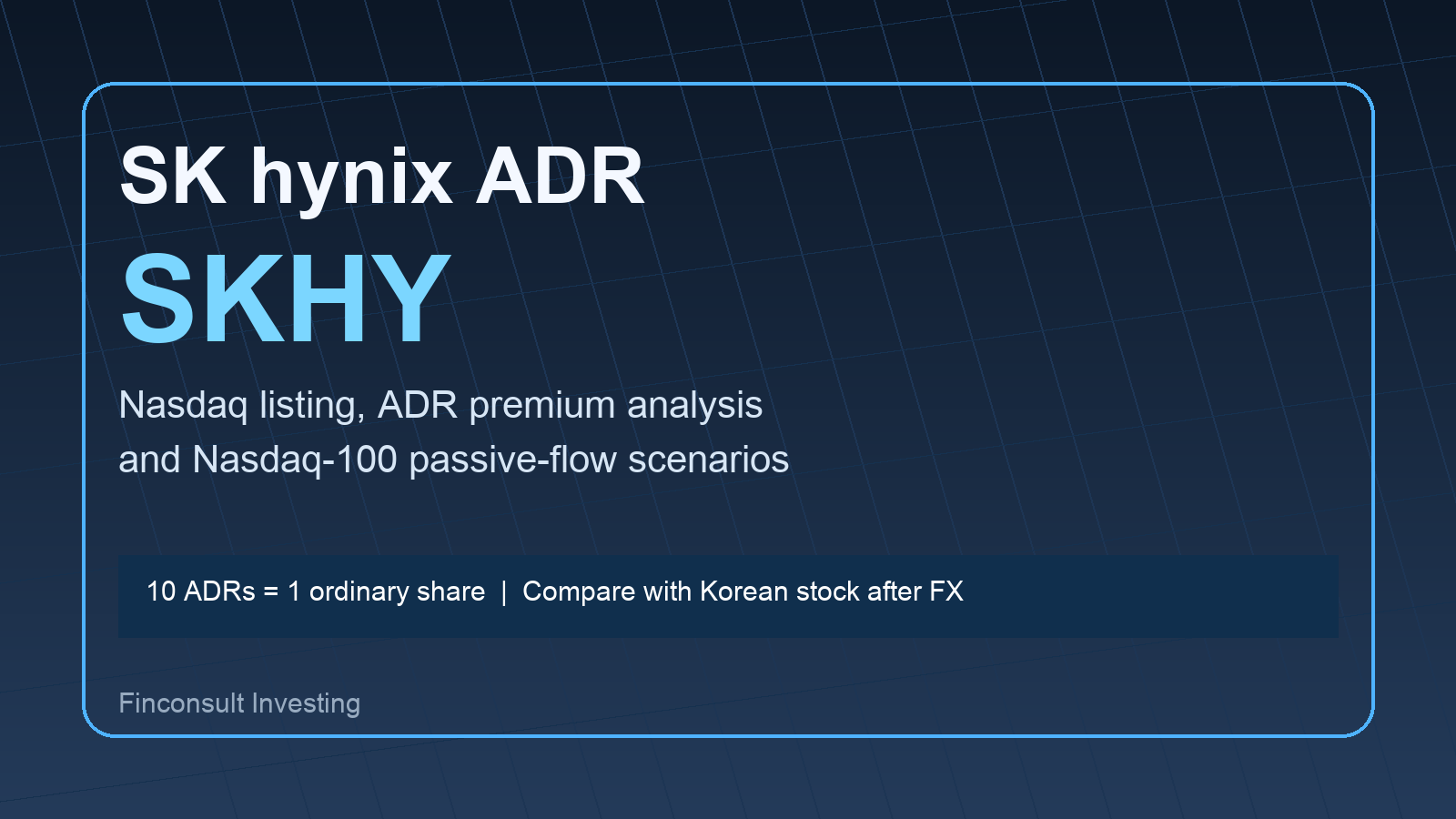
- The SK hynix ADR is expected to trade on Nasdaq under the ticker SKHY, with ten ADRs representing one Korean ordinary share.
- The ADR should be compared with the Korean stock by adjusting for the 10-to-1 ADR ratio and USD/KRW. Based on the July 8 Seoul close, one ADR-equivalent was worth about $137.6 before any market premium or discount.
- A future Nasdaq-100 addition is possible but not automatic. ADR eligibility, seasoning, liquidity, index ranking and the non-primary ADR market-cap calculation all matter.
Introduction: SK hynix walks onto Wall Street’s main stage
The SK hynix ADR listing is not just another foreign listing headline. It is the moment one of Korea’s most important semiconductor companies walks into the loudest, fastest and most valuation-sensitive technology market in the world. Until now, many U.S. investors knew SK hynix as the high-bandwidth-memory supplier behind the AI boom, but buying the stock directly was inconvenient. They needed access to Korean shares, currency conversion, different trading hours and a willingness to think in won while their portfolio lived in dollars. A Nasdaq ADR reduces that friction.
This article explains the event in practical terms. How can investors buy the SK hynix ADR? How should the ADR price be compared with SK hynix’s Korean stock price? Is the ADR trading at a premium or discount? Could SKHY eventually enter the Nasdaq-100? If that happens, how much passive money could be forced to buy? The goal is not to turn excitement into a louder excitement. The goal is to turn excitement into a useful framework.
The currently reported structure is straightforward but important. SK hynix has launched a U.S. ADR offering targeting roughly $28.2 billion, or about 43 trillion won, after revising the target lower as the Korean share price moved down. The company is issuing 17.79 million new ordinary shares, and each ordinary share is represented by ten ADRs. Final pricing is expected after bookbuilding, and trading is expected to begin on July 10, 2026. The expected Nasdaq ticker is SKHY.
That small ticker may change the investor base. Once SKHY appears on U.S. screens, SK hynix becomes easier to place next to Micron, Nvidia, Broadcom, TSMC and ASML. That matters because markets often value companies through comparison. A company sitting in the Korean equity aisle can be treated like a cyclical exporter. The same company sitting beside U.S. AI semiconductor leaders may be treated like a scarce AI infrastructure supplier. The company is the same; the display shelf changes.
What is the SK hynix ADR?
ADR stands for American Depositary Receipt. It is a U.S.-traded receipt that represents shares of a foreign company. Investors buy and sell the ADR in dollars through a U.S. brokerage account, while the underlying share relationship is handled through a depositary structure. ADRs make foreign stocks easier to trade, but they are not magic copies. Investors still need to consider the ADR ratio, currency movements, depositary fees, taxation, liquidity and the relationship between the ADR and the home-market share.
For SK hynix, the key detail is the ratio. Ten ADRs are expected to represent one Korean ordinary share. That means one ADR represents 0.1 ordinary share. This is the first thing investors must understand before judging the price. If the Korean share trades above 2 million won, that does not mean the ADR should trade above $2,000. Because one ADR represents one-tenth of a share, the starting formula is Korean share price divided by ten, then divided by USD/KRW.
For example, SK hynix closed at 2,076,000 won in Seoul on July 8, 2026. Dividing by ten gives 207,600 won per ADR-equivalent. Using a USD/KRW rate of about 1,508.58, that equals roughly $137.6 per ADR. The actual ADR can trade above or below that level depending on the offering price, U.S. demand, sector sentiment, foreign-exchange movement and the time gap between Seoul and New York trading. But this formula is the anchor.
ADR pricing formula: Theoretical SK hynix ADR price = Korean ordinary share price ÷ 10 ÷ USD/KRW. Premium or discount equals the actual ADR price compared with that theoretical value.
How to buy the SK hynix ADR
Once trading begins, investors should be able to search for the ticker SKHY in a brokerage account that supports Nasdaq-listed equities. U.S. investors may use platforms such as Fidelity, Charles Schwab, Interactive Brokers, Robinhood or other brokers, subject to availability. Korean investors can use a domestic broker that supports overseas stock trading or a global broker account. The mechanics should feel similar to buying a U.S.-listed stock: search the ticker, review the quote, choose the order type and submit the trade.
The first trading day deserves extra care. Newly listed securities often experience wide spreads, uneven liquidity and fast price discovery. Investors should consider using limit orders rather than market orders. A market order says, in effect, “buy at whatever price is available.” On a busy listing day, that kindness can be expensive. A limit order forces the trade to respect the price you choose.
Before placing an order, investors should check five things. First, the final offering price. Second, the latest Korean ordinary share price. Third, the USD/KRW exchange rate. Fourth, the bid-ask spread in SKHY. Fifth, broader semiconductor sentiment in the U.S. market. If Micron, Nvidia and AI infrastructure stocks are falling sharply, SKHY may trade differently from the Korean close. If the U.S. market is rewarding AI chip exposure, the ADR may command a premium.
Investors outside the U.S. should also review tax and fee treatment. ADRs may involve depositary fees, foreign withholding tax on dividends, local capital-gains rules, currency conversion costs and brokerage commissions. For some investors, the Korean ordinary share may be cheaper or more tax efficient. For others, the convenience and liquidity of the ADR may justify the extra layers. The right choice depends on account access, holding period, tax status and trading style.
SK hynix ADR price versus Korean stock price: premium and discount analysis
The most entertaining part of a cross-listing is the price comparison. Two markets, one company and a line of traders trying to decide whether Wall Street is paying too much or Seoul is too pessimistic. But the comparison must be done properly. The ADR is not one full Korean share. It is one-tenth of a Korean share. The Korean price must be converted into a per-ADR dollar value before any premium or discount can be discussed.
| Input | Number or formula | Interpretation |
|---|---|---|
| Korean ordinary share close | 2,076,000 won on July 8, 2026 | Seoul market reference price |
| ADR ratio | 10 ADRs = 1 ordinary share | One ADR represents 0.1 ordinary share |
| Won value per ADR-equivalent | 2,076,000 ÷ 10 = 207,600 won | Local value before currency conversion |
| USD/KRW | About 1,508.58 | Reference exchange rate |
| Theoretical ADR value | 207,600 ÷ 1,508.58 = about $137.6 | Dollar value implied by the Korean close |
| Earlier reference offering level | 242,500 won per ADR, or about $160.7 | About 16.8% above the July 8 Seoul-close equivalent |
The earlier 242,500 won reference is not necessarily the final offering price. Reports indicate that SK hynix revised the offering target lower after the Korean share price declined, and final pricing is expected after bookbuilding. If the final ADR price moves closer to the July 8 Korean close, the premium narrows. If U.S. demand remains strong, the premium can persist. The important point is that investors should not look at the U.S. quote in isolation. They should compare it with the Korean share price after adjusting for ratio and currency.
A premium is not automatically irrational. U.S. trading access, dollar liquidity, Nasdaq visibility, investor familiarity and potential index inclusion can all support a premium. A discount is not automatically a bargain either. It can reflect dilution from new shares, weak semiconductor sentiment, concern about the memory cycle, large offering supply or uncertainty around final pricing. The premium or discount is a diagnostic tool, not a verdict.
The offering size and dilution question
The scale of the transaction is extraordinary. A roughly $28 billion U.S. share sale is not a symbolic listing. It is a major capital raise. SK hynix plans to use proceeds for manufacturing expansion in Korea and production equipment, including advanced tools such as ASML’s EUV scanners. That fits the strategic moment. AI memory is not won with slogans. It is won with capacity, yield, packaging, power infrastructure, customer qualification and relentless execution.
For investors, the offering has two sides. On the positive side, SK hynix gets more capital to defend and expand its high-bandwidth-memory leadership. AI infrastructure customers need reliable supply, and memory capacity takes time to build. A Nasdaq listing also broadens the shareholder base and may help the market compare SK hynix more directly with U.S.-listed semiconductor peers.
On the negative side, new shares dilute existing shareholders. Dilution can be a good trade if the capital earns attractive returns, but it still matters. A large offering also creates short-term supply. Investors who receive allocations may sell, hedge or rotate. Existing investors may rebalance. Short-term volatility after the listing would not be surprising. Big events attract big orders, and big orders rarely move in a perfectly straight line.
Could SKHY be added to the Nasdaq-100?
The Nasdaq-100 question is where excitement and methodology collide. The Nasdaq-100 includes 100 of the largest non-financial companies listed on Nasdaq. The index is tracked by major products such as Invesco QQQ, QQQM and many international Nasdaq-100 funds. If a stock is added, index-tracking funds must buy it. That is why investors care.
Nasdaq’s methodology allows American Depositary Receipts to be eligible securities. It also distinguishes between primary ADRs and non-primary ADRs. SK hynix would appear closer to a non-primary ADR because the underlying ordinary shares continue to trade in Korea. This matters because Nasdaq’s methodology says that for non-primary ADRs, full market capitalization for selection purposes is based on the total value of listed depositary shares reported by depositary banks. Foreign-listed underlying shares and unlisted shares are not included.
This is the nuance many casual discussions miss. SK hynix’s total Korean-market value is enormous. Based on the July 8 market data, it was close to 1,479 trillion won, or roughly $980 billion at the reference exchange rate. But Nasdaq-100 index treatment may not simply import that entire Korean-market capitalization. If the listed ADR value begins around the offering size, the index-relevant number could be far smaller than the company’s total global equity value. Over time, if more underlying shares are deposited and the ADR base expands, that can change. At the start, investors should not assume that a trillion-dollar Korean market capitalization automatically means a trillion-dollar Nasdaq-100 weight.
There is also seasoning. Nasdaq methodology generally requires a security to be listed and available for trading on a seasoning exchange for at least three full calendar months, excluding the initial listing month. A July 10 listing could therefore build seasoning through September, October and November for possible December reconstitution consideration, assuming other requirements are met. The methodology also has fast-entry provisions for very large new listings, but those depend on the security’s full market capitalization ranking and other eligibility criteria.
| Requirement | Why it matters for SKHY | What to watch |
|---|---|---|
| ADR eligibility | ADRs can be eligible securities under Nasdaq-100 methodology | How Nasdaq classifies SKHY |
| Non-financial status | SK hynix is a semiconductor company, not a financial firm | ICB industry classification |
| Nasdaq listing | The ADR is expected on Nasdaq Global Select Market | Actual first trading day and exchange status |
| Seasoning | Three full calendar months are normally required | December reconstitution or fast-entry pathway |
| Market-cap calculation | Non-primary ADRs may be judged by listed depositary-share value | ADR share count reported by depositary banks |
| Liquidity | Nasdaq-100 methodology includes a minimum ADVT test | Early trading volume and spreads |
Passive money inflow: real, but scenario-dependent
Passive money is the fuel behind the Nasdaq-100 debate. Invesco QQQ alone is one of the most traded ETFs in the U.S. and provides exposure to the Nasdaq-100. Add QQQM, international Nasdaq-100 ETFs, institutional mandates and derivative hedging, and the pool of money linked to the index is enormous. When an index adds a new company, funds tracking that index have to buy the stock in proportion to its weight.
For SKHY, the key is the weight. If the index uses only the listed ADR value and that value is near the offering size, the passive flow would be meaningful but not gigantic relative to SK hynix’s global market value. If the ADR base grows over time and the listed depositary-share value expands materially, the potential index weight and passive buying could become much larger. These are very different scenarios.
Investors should also watch the Philadelphia Semiconductor Index and semiconductor ETFs. A U.S. listing makes SK hynix easier for U.S. semiconductor funds to trade, compare and potentially include, depending on their rules. The SOX-related pathway may matter before the Nasdaq-100 pathway. A fund manager who previously hesitated to use Korean ordinary shares can now look at SKHY beside Micron. That comparison alone can influence active flows even before passive index flows arrive.
There is a familiar market pattern around index events. Active investors buy the possibility. Passive funds buy the rule. Traders buy the announcement and sometimes sell the effective date. This means index inclusion can be bullish in anticipation but messy in execution. The cleanest conclusion is that passive flow is a real potential catalyst, but it should be valued with scenarios rather than slogans.
Valuation re-rating: what happens when SK hynix sits beside Micron?
The largest strategic change may be comparability. In Korea, SK hynix trades inside a local market framework: Kospi flows, won liquidity, foreign ownership, Samsung Electronics comparisons and domestic macro sentiment. In the U.S., SKHY will be placed beside Micron, Nvidia supply-chain names, AI infrastructure beneficiaries and global semiconductor peers. The market will ask a different question. Instead of “how should a Korean cyclical memory stock trade?”, investors may ask, “what is the correct multiple for the leading HBM supplier to the AI boom?”
That framing can support a valuation re-rating. Reports citing Counterpoint Research put SK hynix’s share of global HBM revenue at 57% in the fourth quarter of 2025. If investors believe HBM remains structurally scarce and strategically essential, they may value SK hynix more like an AI infrastructure supplier than a classic memory-cycle company. That is the bull case in one sentence.
The bear case is also simple. Memory remains cyclical. Supply eventually responds to high prices. Customers negotiate. Competitors catch up. AI data-center spending can pause. If HBM margins normalize or if capex races ahead of demand, a Nasdaq listing will not protect the stock. Wall Street can reward a narrative aggressively, but it can also punish disappointment aggressively. A brighter spotlight makes the stage more visible; it does not remove the floor.
Key risks investors should not ignore
The first risk is offering price risk. If the ADR is priced at a large premium to the Korean share-equivalent value, short-term upside may already be pulled forward. If it is priced at a discount, the market may ask why. The second risk is dilution. The company is issuing new shares, and investors must judge whether the capital raised will generate returns above the cost of dilution.
The third risk is foreign exchange. ADR investors hold a dollar-traded security tied economically to a Korean company and a Korean ordinary share. USD/KRW can change returns even when the local share price behaves as expected. The fourth risk is the semiconductor cycle. HBM is hot, but memory is still a supply-demand business. The fifth risk is customer concentration. AI memory demand is tied to a relatively small number of large accelerator and cloud customers.
The sixth risk is expectation. SK hynix is a high-quality company with a strong AI memory position, but the market already knows that. A great company can still be a poor investment if bought at the wrong price. Investors should separate the business question from the price question. “Is SK hynix important?” and “Is SKHY attractive at this quote?” are not the same question.
First-day checklist for SKHY
On the first trading day, investors should watch the final offering price, the latest Korean ordinary share price, the USD/KRW rate, the ADR bid-ask spread and U.S. semiconductor sector performance. They should calculate the implied Korean-share equivalent before buying. The most useful question is not “is everyone excited?” but “what Korean share price am I effectively paying after ratio and currency conversion?”
More advanced investors can monitor option-listing potential, short interest, borrow availability, premarket liquidity, ADR fee disclosures, institutional allocation details and the relationship between SKHY and Micron. But the basic discipline is enough for most people. Do the conversion. Check the spread. Use a limit order. Decide whether you are buying the company, the listing event or the index-inclusion dream. Those are three different trades.
Conclusion: SKHY is not just a ticker; it is an investor-base reset
The SK hynix ADR listing gives the company capital, visibility and a direct U.S. trading channel. It gives investors a simpler way to own one of the most important suppliers in the AI memory chain. It also gives the market a new comparison framework. Once SKHY is on Nasdaq, SK hynix can be judged in the same screen as Micron and other AI semiconductor names. That can change the conversation.
But investors should bring arithmetic to the party. Ten ADRs represent one ordinary share. The Korean price must be adjusted for the ADR ratio and USD/KRW. Premium and discount are not feelings; they are calculations. Nasdaq-100 inclusion is possible, but it depends on eligibility, seasoning, liquidity, ranking and the non-primary ADR market-cap treatment. Passive money inflow is a catalyst, not a guarantee.
The balanced view is this: SKHY is a major event for global AI semiconductor investing, but the smartest investors will treat it as both an opportunity and a test. The opportunity is easier U.S. access to SK hynix. The test is whether investors can resist buying the headline before checking the math. In a market this excited about AI memory, that discipline may be the real edge.
References and Related Topics
- CNBC, South Korea’s SK Hynix plans $29 billion Nasdaq ADR listing.
- Yahoo Finance / Quartz, SK Hynix launches $28 billion Nasdaq ADR listing.
- Nasdaq, Nasdaq-100 Index Methodology.
- Google Finance, SK Hynix Inc. 000660:KRX market data, accessed July 8, 2026.
Related Topics: SK hynix ADR, SKHY, Nasdaq listing, how to buy SKHY, HBM, Micron, Nvidia supply chain, Nasdaq-100 addition, QQQ passive inflow, ADR premium discount, Korea stock ADR analysis.
Language versions:
한국어 원문 |
English version