
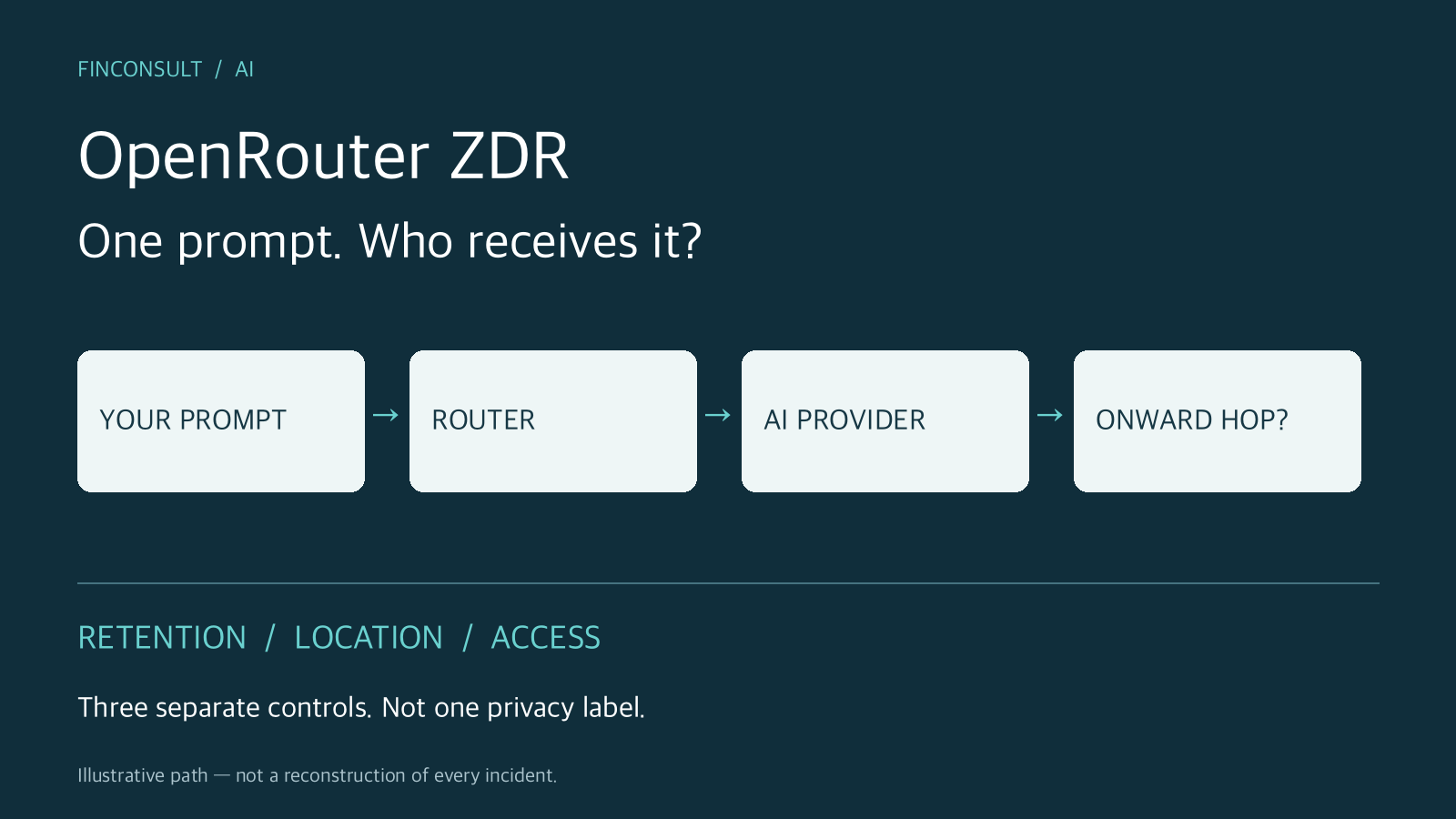
Three providers removed and 125 endpoints stripped of eligibility expose a bigger procurement problem: knowing the model is not enough.
Summary
- OpenRouter removed three providers and withdrew ZDR eligibility from 125 endpoints, including precautionary removals.
- Provider notices describe different failures: stolen stored samples, compromised live processing and undisclosed forwarding.
- Buyers need enforceable routing, traceable data paths and downstream accountability—not just cheaper tokens.
Introduction
The OpenRouter ZDR (zero data retention) review challenges a comforting assumption: that choosing a model and switching on privacy controls settles where business information goes. On November 22, the AI routing platform announced provider removals and a broad eligibility reset after researchers identified data-handling failures.
The scale needs careful interpretation. The 125 endpoints are not 125 confirmed breaches: some removals were precautionary. OpenRouter says the findings did not show unauthorized access to its own systems. Its notice links several provider statements but does not identify the three removed businesses. Listing a statement does not establish that its author was removed. [1]
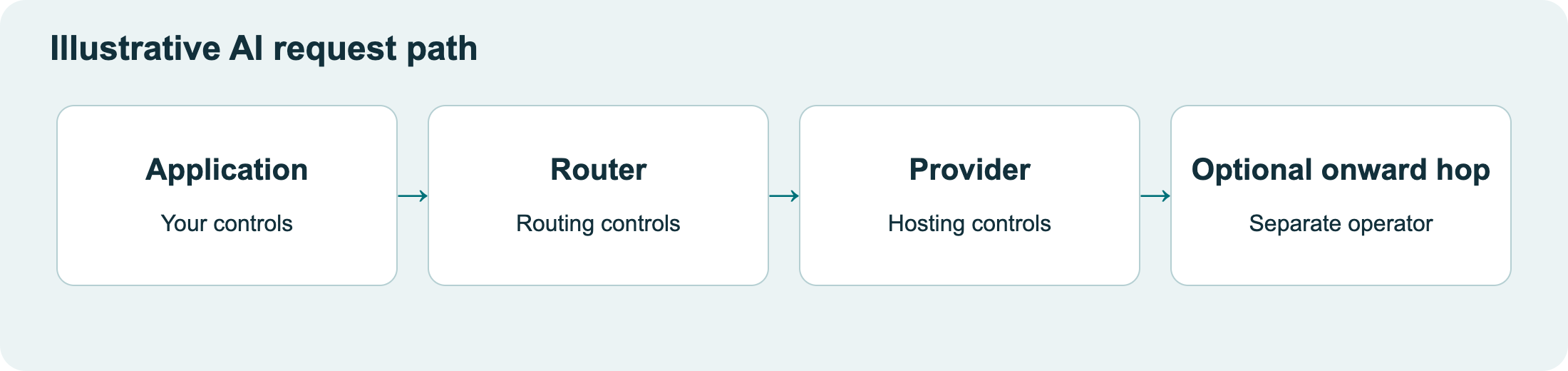
The central issue is the gap between a privacy promise and a verifiable processing chain. A single API can conceal several organizations, each with a different opportunity to store, forward or expose a request.
Main Analysis: the OpenRouter ZDR gap
The same prompt, different failure mechanisms
Dragos reports sending approximately two million instrumented prompts between July and November. Unique links and controlled credentials allowed researchers to observe subsequent access. That is a count of test prompts—not affected customers or confirmed stolen conversations. The research describes intrusions, reseller access and apparent policy failures. [2]
A canary is a deliberately planted tripwire. Credential abuse offers stronger evidence of unauthorized activity than an isolated URL fetch, which requires context. The tests do not yield an industry-wide breach rate; silence from a token cannot prove a request stayed private.
| Provider | Disclosed mechanism | What remains uncertain |
|---|---|---|
| Together AI | A coding agent exposed a repository credential; an unauthorized party downloaded stored June/July prompt samples. | Contents and affected-customer review continued. [3] |
| Phala | An attacker accessed an inference deployment, exposing data during processing. | Its preliminary report retains a wider precautionary window than the confirmed canary dates. [4] |
| Novita | A configuration issue forwarded some MiniMax traffic to MiniMax’s API rather than Novita-hosted infrastructure. | Further handling and deletion remained under verification. [5] |
These distinctions change the remedy. Deleting logs will not stop interception during live processing. Fixing a forwarding rule does not revoke a credential already copied. Together attributes its incident to a credential committed by an AI coding agent, but the deeper control question is why production-derived samples and repository access could combine into a usable exposure path.
Why OpenRouter ZDR is not a universal privacy guarantee
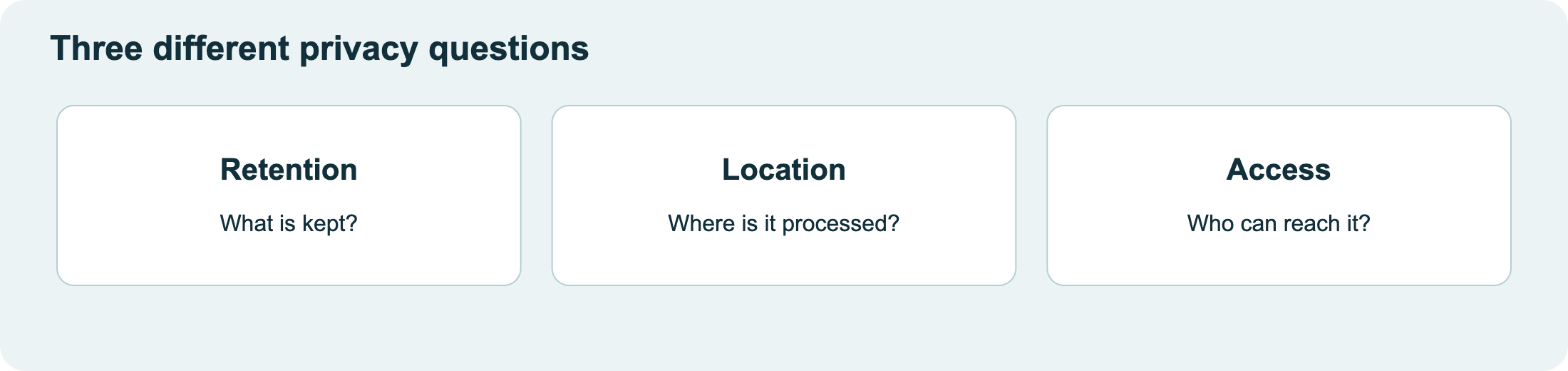
ZDR addresses routine retention after processing; it does not mean an inference provider never receives the information. Nor does “not used for training” necessarily mean “not stored.” Processing location, access permissions and retention are separate controls. [6]
OpenRouter’s documentation also describes exceptions and boundaries: legal/CSAM-related handling, in-memory caching, application logs and external tools require attention. Its separate Safety Retention tier permits storage for abuse prevention without training. Importantly, zdr: true follows account and guardrail choices; where Safety Retention is allowed, that flag alone is not strict ZDR-only routing. [7]
Buyers must therefore verify the effective configuration, not the presence of a setting. OpenRouter supports provider restrictions and fallback controls, while default routing balances several performance and cost factors—not simply the cheapest advertised price. [8]
The contract reveals the accountability gap
OpenRouter’s published data-processing agreement, updated August 26, states that ZDR-eligible listing reflects providers’ represented policies and is not OpenRouter’s guarantee of their compliance. This is a contractual distinction between selecting a policy and warranting its execution—not a conclusion that the platform has no obligations. [9]
Where GDPR applies, Article 28 requires processor authorization, contractual safeguards and obligations flowing to other processors. Actual roles, agreements and facts determine responsibility. A registry disclaimer is not a blanket exemption from applicable law. [10]
The procurement implication is substantial: ask who answers when a subcontractor breaks the rule, not merely whether a privacy page displays the right words.
Practical and Investment Implications
What enterprise buyers should require
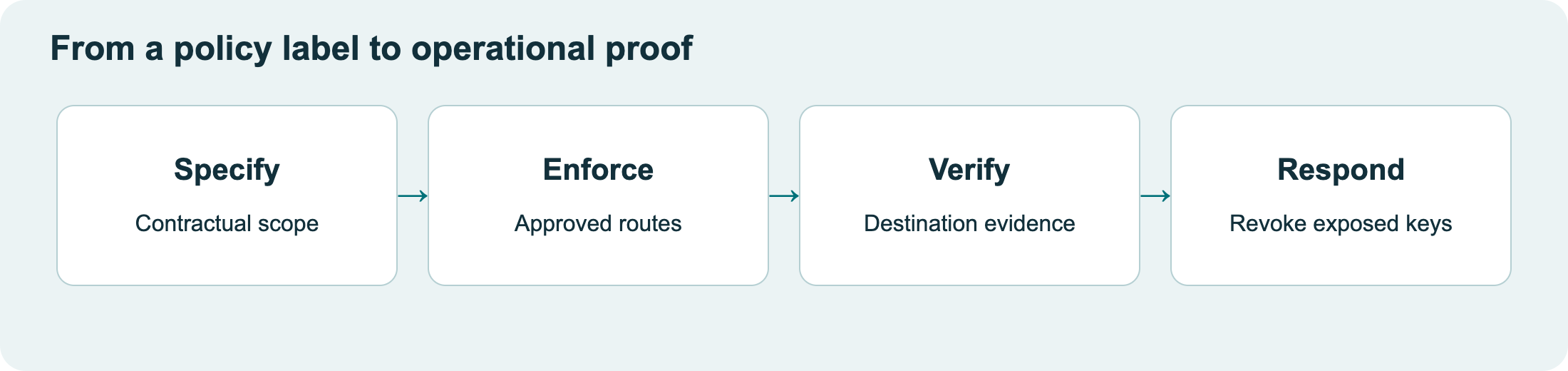
A workable contract should connect the data policy to operational evidence. The following are negotiation priorities, not claims that every customer already has these rights:
- Name the chain. Identify operators, locations and onward processing; require notice and approval rights for material changes.
- Define retention precisely. Cover inputs, outputs, files, logs, caches, testing samples and exceptions, with deletion timelines.
- Fail closed. If no approved endpoint is available, stop the sensitive request rather than silently relax policy.
- Preserve evidence. Require request-level destination records, investigation cooperation, notification deadlines and deletion attestations without duplicating sensitive prompt content.
- Allocate responsibility. Specify audit scope, subcontractor duties, remedies and assistance with credential replacement.
Teams investigating possible exposure should preserve relevant request identifiers, match provider routes and dates, and revoke or rotate credentials actually implicated. Reverting a code commit does not invalidate a copied key. OWASP recommends prompt revocation, replacement and auditability for exposed secrets. Avoid sending fresh secrets to reproduce an incident. [11]
For coding agents, remove unnecessary access to secret files, use short-lived scoped credentials and scan changes before publication. Any detection system that retains whole prompts can create another sensitive dataset; record only what the investigation requires.
Who might gain—and why the outcome is not predetermined
Our assessment is that demand could shift toward providers offering demonstrable data-path control, incident transparency and enforceable enterprise terms. Security gateways and monitoring vendors may benefit, but need evidence of deployment and willingness to pay. A larger cloud is not automatically immune, and a smaller operator is not automatically unsafe.
Routers also have a credible upside: a shared verification layer could spread auditing costs across customers. OpenRouter says it is adapting continuous testing and technically checking network paths. The competitive question is whether those measures reliably constrain real traffic, not whether the marketplace abandons routing. [1]
Compare total cost: token charges, integration, monitoring, restricted-provider capacity and incident response. Direct contracting may simplify accountability; self-hosting can reduce outside processing but adds patching, access-control and operational duties. Neither is a free security upgrade.
Watch for full root-cause reports, customer-scope clarification, independently supported remediation and explicit criteria for restoring endpoint eligibility. Without those, claims of a permanent revenue shift or a measurable security premium remain hypotheses, not forecasts.
Conclusion
The OpenRouter ZDR episode is not evidence that every router fails or every privacy promise is worthless. It shows why a model name, a provider brand and a retention setting cannot substitute for one another.
For businesses, the next purchasing question is not only “How much does inference cost?” It is “Can we establish who processes this information, under which enforceable rules, and what happens when those rules fail?” That is where price comparison becomes supply-chain governance.
Sources
- OpenRouter incident notice · 2026-11-22
- Dragos canary research · 2026-11-19
- Together AI incident notice · 2026-11-21
- Phala preliminary report · 2026-11-10; preliminary
- Novita privacy notice · 2026-11-22
- ZDR explained · accessed 2026-11-22
- ZDR policy and settings · accessed 2026-11-22
- Provider routing · accessed 2026-11-22
- Data-processing agreement, §2.4 · updated 2026-08-26
- GDPR, Article 28 · Regulation (EU) 2016/679
- OWASP: secrets management · accessed 2026-11-22