

November 4, 2026 | Category: AI
Summary
- The global IT services “Big Five” (HCL, TCS, Infosys, Cognizant, Accenture) all reported in October. AI services revenue is no longer a forecast — it is booked, recorded revenue.
- But as AI revenue grows, legacy (non-AI) IT services revenue is shrinking. The industry is in the stage of “replacement,” not “addition.”
- Two of the five companies cut growth guidance. Management avoids the word “recovery” and hangs its outlook on one yardstick: the 2027 macro.
(Advertisement)
Bottom line first: the revenue is real
In October, the global IT services “Big Five” — HCL, TCS, Infosys, Cognizant and Accenture — held their earnings calls one after another. One question ran through all five: “Is AI finally becoming revenue?”
The answer was clear: yes. TCS’s annualized AI services revenue reached $3.1 billion (about 4 trillion won), more than 10% of total revenue. Infosys’s AI revenue share hit 10.5%, up 29% in one quarter. HCL booked $219 million of AI revenue, up 78% year over year.
But there is a catch. Overall growth at all five was only 1.5–7% — even though AI revenue grew 20–80%. The reason: the revenue that existed before AI arrived is shrinking. The unremarkable 1.5–7% rates are the net result of AI revenue rising while the legacy base erodes.
Key takeaway: AI services revenue is real and growing fast. At the same time, it is eating into legacy IT services revenue. “AI is driving growth” is an overstatement; “AI is restructuring the business” is the current reality.
The numbers behind “AI revenue”
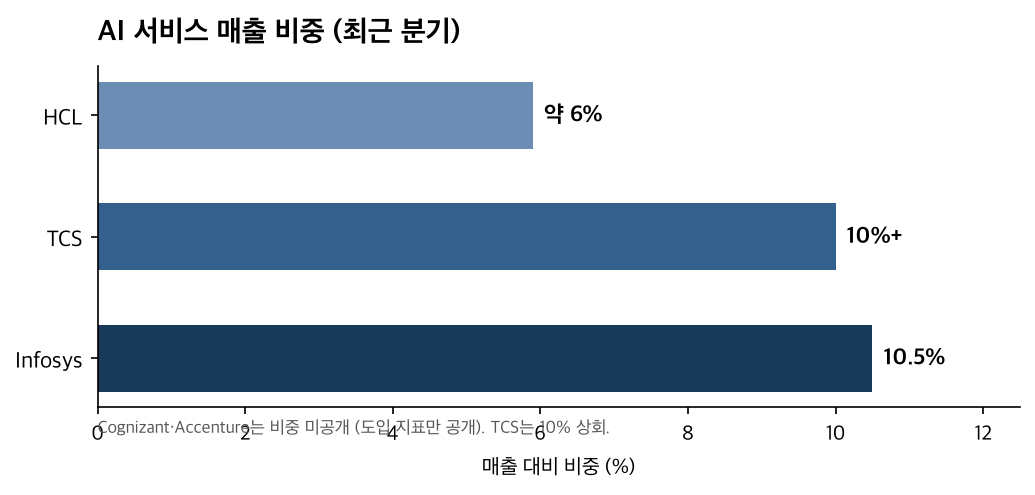
Infosys’s AI share is 10.5%, TCS has crossed 10%, HCL is around 6%. More important than the size is that this is recorded revenue, not expected revenue. TCS said “the margin on AI revenue is far above the company average”; HCL puts its advanced AI service margin 7–10 points above standard businesses.
On the client side, Accenture says more than 400 enterprises initiated large-scale AI work for the first time in the past year — roughly 100 in Q4 alone. Cognizant counts over 8,500 AI engagements, with 40% of its portfolio growing two to three times faster than the rest. In HCL management’s words, “deals without AI have become the exception.”
The shape of demand is changing, too. TCS splits AI demand into three streams — AI-native solutions, AI-led transformation of enterprise systems, and autonomous global business services (GBS): clients moving from buying “heads” to buying “outcomes.” And AI infrastructure itself — data centers, platforms, cyber-OT security — is becoming a new revenue line: HCL’s AI data center business grew 64% quarter over quarter.
The partnership map is being redrawn as well. HCL is a premier partner of Anthropic and an advanced partner of OpenAI; Accenture is the number-one partner of all three top U.S. frontier labs. On-site capability — governance, data, deployment — is starting to make money, rather than the models themselves.
Yet the legacy revenue is shrinking
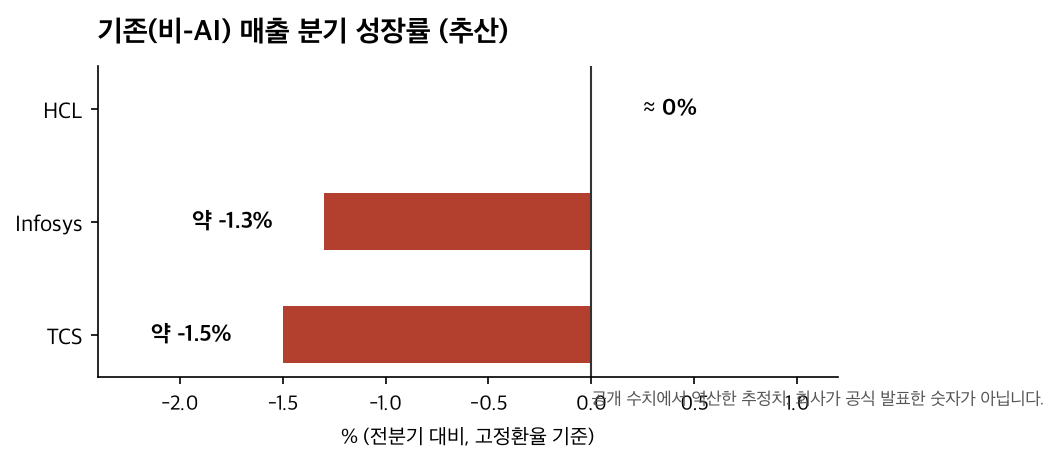
The plot twist: even with AI revenue up 20–80%, total growth stays at 1.5–7%. Back-calculating from disclosed numbers, TCS’s non-AI revenue fell about 1.5% quarter over quarter and Infosys’s about 1.3%; HCL barely holds flat. AI is acting as a “replacement,” not an “addition.”
Two causes. First, clients demand a share of AI’s productivity gains: “If AI cut the effort, cut the price.” Infosys admitted competitors are aggressively cutting prices on 3–5-year contracts; Accenture said pricing fell “in many areas” in Q4.
Second, the IT budget itself is not growing. Accenture is “assuming kind of more of the same” for 2027 client budgets, and all five agree “discretionary programs without near-term value remain under scrutiny.” The total budget is flat; its composition is rotating.
That said, the deflation may be running out. Cognizant says roughly half its portfolio has already been rebaselined for productivity, with new business up from 48% to 60% of the mix; HCL says its top-client ramp-downs have “already played out”; Infosys calls the legacy productivity hit “a finite period.”
One structural shift may change the equation: contracts are moving from time-and-material to fixed-price, outcome-based delivery. Cognizant’s fixed-price/outcome share is about 58% of revenue, and over 65% of Accenture’s bookings run on the model. Splitting AI productivity gains with clients “as outcomes” could reverse the deflation debate.
Why management won’t say “recovery”
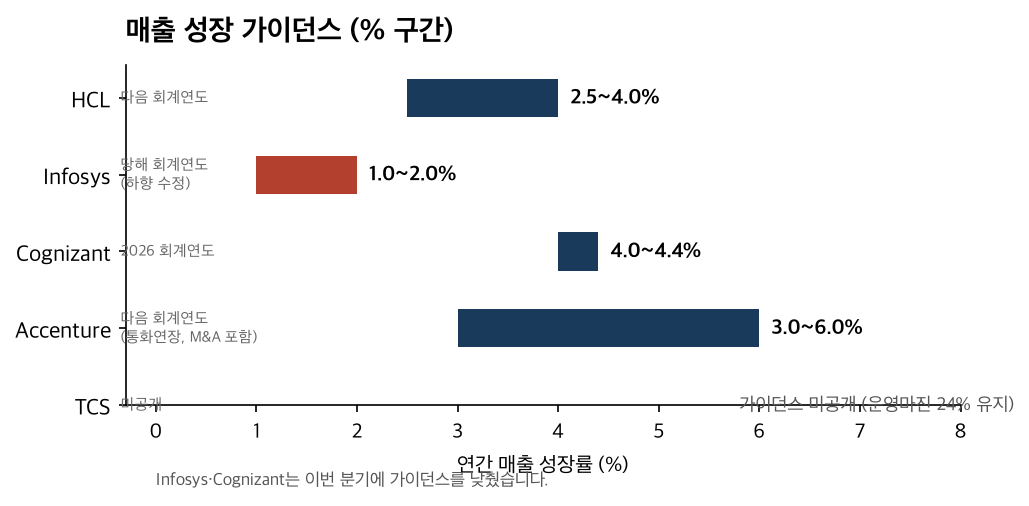
Management is far more cautious than the AI numbers suggest. Two of the five cut growth guidance this quarter: Infosys to 1–2% for FY27, Cognizant to 4.0–4.4%. Accenture beat its own top end, yet its FY27 guide (3–6%) assumes “stable” at the top and “deterioration” at the bottom. Averaging the five midpoints, next year’s organic growth is roughly 2–4%.
TCS gave no guidance, repeating only its 26–28% operating margin “North Star.” HCL expects to “slightly beat the midpoint” of its 3–4% guide — and still refused to raise it.
Four variables appear in every call: the Middle East conflict (a roughly $1 billion annualized headwind for Accenture), U.S. healthcare funding regulation (Medicaid/Medicare), soft consumer spending, and rising rate expectations. On the flip side, Accenture sees U.S. federal spending as a “significant contributor” to FY27 after its large federal contract sunsets.
The bright spot is financial services (BFSI) — the only consistent growth engine. All five point to banking as their surest axis: Cognizant’s financial unit grew double digits for a third straight quarter, BFSI was TCS’s largest growth contributor, and HCL’s financial revenue rose 7.1%. Consumer, telecom and U.S. healthcare remain weak.
Timing matters too. This year’s record bookings mostly convert to revenue in 2028 — Infosys’s $2 billion-plus, seven-year mega deal adds over 1 point of growth only next fiscal year. Management is confident about “2028” and cautious about “next year.”
The Big Five at a glance
| Company | Latest quarter revenue growth | AI revenue signal | Next-FY guidance |
|---|---|---|---|
| HCL | +2.6% | $219M AI revenue, +78% YoY | 2.5–4% |
| TCS | +2.8% | $3.1B annualized, 10%+ of revenue | None given (24% op margin) |
| Infosys | +1.5% | 10.5% of revenue, +29% QoQ | 1–2% (cut) |
| Cognizant | +4.8% | 8,500+ AI deals; 40% of portfolio growing 2–3x | 4.0–4.4% (cut) |
| Accenture | +7% (local currency) | 400+ new AI clients; partner bookings 3x | 3–6% (local currency) |
Bookings — the honest leading indicator — are strong: HCL $3.3 billion in the quarter (+27% YoY), Infosys $5.2 billion TCV (62% net new), Accenture $84.5 billion for the year with 141 deals over $100 million, Cognizant book-to-bill 1.3x, TCS $9.6 billion TCV. Much of the “2027 revenue” debate is already answered by these numbers.
What it means for investors
The investment case can no longer be reduced to “AI beneficiary.” Four points to watch: does AI revenue outpace the legacy decline; is price competition intensifying or easing; how much of the record backlog converts, and how fast; and can margins hold while productivity savings are reinvested?
EPS growth is also outrunning revenue. Cognizant guides revenue at 4.0–4.4% but EPS at 8–10%, as the rising AI share tilts the portfolio toward higher-margin work. This cycle, margin “mix” — not revenue “level” — will likely drive earnings.
Part of next year’s growth will be bought, not earned: Accenture has a roughly $5 billion FY27 M&A pipeline, and TCS is acquiring the VW Group’s AI mobility unit (MHP). 2–2.5 points of Accenture’s guide and about 1.5 of Cognizant’s come from M&A — organic growth is the number underneath.
One risk was de-risked: HCL and Cognizant both assessed the U.S. PERM visa suspension as immaterial, lowering a staffing risk that had hung over the Indian majors for years. And the industry is investing while holding margins — TCS is building next-generation bench, Infosys carried two wage hikes, and HCL’s Project Ascend alone added 73 bps to quarter margin. Read margins as a floor, not a trend line.
Investment implication: Line up the AI revenue growth rates (+20–80%) against the legacy revenue decline (–1–2%) and today’s AI looks closer to “replacement.” The moment AI becomes genuine “additional” revenue will be the inflection point for this industry’s earnings.
Checkpoints
They are specific. January: HCL, TCS and Infosys earnings show the cross-over point between AI and legacy revenue. February: Cognizant’s FY27 guidance reveals the intensity of price competition. And client 2027 budget-setting yields the first evidence on whether “discretionary recovery” is real. Watch three metrics: non-AI revenue QoQ growth, the tone of pricing commentary, and the speed of AI expansion beyond BFSI.
Risk check: The biggest risk is “AI deflation” — AI can shrink legacy revenue before it builds new revenue. No matter how large the backlog, if conversion is slow and prices keep falling, guidance cuts will repeat.
In short
AI services work is no longer a story — it is revenue that is actually happening and growing fast. What is unproven is whether that growth is big enough to replace the shrinking legacy base. So management says “AI revenue is real” while tacking “the macro has to improve first” onto its guidance. For the next half-year, “legacy revenue decline rate” matters more than “AI revenue.” The first answers come in the earnings calls of the next one to two months.
Related Topics
- Why the payoff of AI investment is still not visible outside Big Tech
- “90% of our code is written by AI” — the collision inside security firm Proton
- The AI deskilling paradox: work got faster, but who trains the next generation of professionals?
- The Democratic AI regulation agenda: three policies that could change data center investment
Key Sources
- HCLTech Q2 FY27 earnings release (2026.10.12) — HCLTech Investor Relations
- TCS Q2 FY27 earnings release (2026.10.08) — TCS Investor Relations
- Infosys Q2 FY27 earnings release (2026.10.23) — Infosys Investor Relations
- Cognizant Q3 2026 earnings release (2026.10.29) — Cognizant Investor Relations
- Accenture Q4 FY2026 earnings release (2026.10.01) — Accenture Newsroom
- SEC EDGAR — Accenture filings (10-K)
- SEC EDGAR — Cognizant filings (10-K)
- SEC EDGAR — Tata Consultancy Services filings (20-F)
- SEC EDGAR — Infosys filings (20-F)
- SEC EDGAR — HCL Technologies filings (20-F)