Publication date: July 10, 2026
Category: AI
Summary
- Meta Muse Spark 1.1 is not just another model update. It is Meta’s move from “AI inside Meta products” toward a developer API that competes for agentic coding, tool use, and enterprise workflow automation.
- Reuters, cited by TechCrunch, reports pricing of $1.25 per million input tokens and $4.25 per million output tokens. That is not the cheapest price in AI, but it is aggressive for a Western big-tech agent model.
- The real competitive pressure comes from both sides: Anthropic and OpenAI at the premium end, and Chinese low-cost models such as DeepSeek, Kimi, and Qwen pushing the floor price lower.
(Advertisement)
Meta Muse Spark 1.1: Why This Launch Matters
Meta Muse Spark 1.1 is Meta’s clearest attempt yet to re-enter the serious AI model race with a paid developer product. For years, Meta was the company that made open-weight AI feel mainstream. Llama gave developers a powerful alternative to closed systems, and it earned Meta enormous goodwill. But goodwill is not the same as API revenue. In the market where developers pay per token, OpenAI, Anthropic, Google, DeepSeek, Kimi, and Qwen have looked more commercially relevant than Meta.
Muse Spark 1.1 tries to change that. TechCrunch reported that Meta publicly launched the new model on July 9, 2026, describing it as a multimodal AI model designed for agentic coding. The first version of Spark was announced in April, but this release matters more because it arrives with developer access through the Meta Model API public preview. In AI, a model announcement is interesting. A model that developers can actually call, test, compare, and build products around is strategically much more important.
Meta’s positioning is very clear. Muse Spark 1.1 is not being sold as a cute chatbot. It is being pitched as a model for multistep reasoning, complex workflows, computer use, tool use, bug fixing, enterprise feature deployment, and large code migrations. That sounds less glamorous than a viral consumer chatbot, but it is where a lot of real AI spending is moving. Enterprises do not only want charming answers. They want software bugs fixed, ad reviews automated, customer-support tickets handled, documents searched, browser tasks completed, and internal systems connected without a human clicking every button.
The timing is also revealing. The Financial Times reported that Meta had relied on Google Gemini for internal safety processes, customer-service workflows, advertising help chatbots, and some coding use cases. Google reportedly capped Meta’s Gemini usage after Meta sought more capacity than Google could provide. That is a remarkable situation: one of the world’s largest technology companies, spending extraordinary amounts on AI infrastructure, still had meaningful dependence on a rival’s model capacity. Muse Spark 1.1 is partly a product launch, but it is also a supply-chain response.
Meta’s Pricing Strategy: Not the Cheapest, But Definitely Aggressive
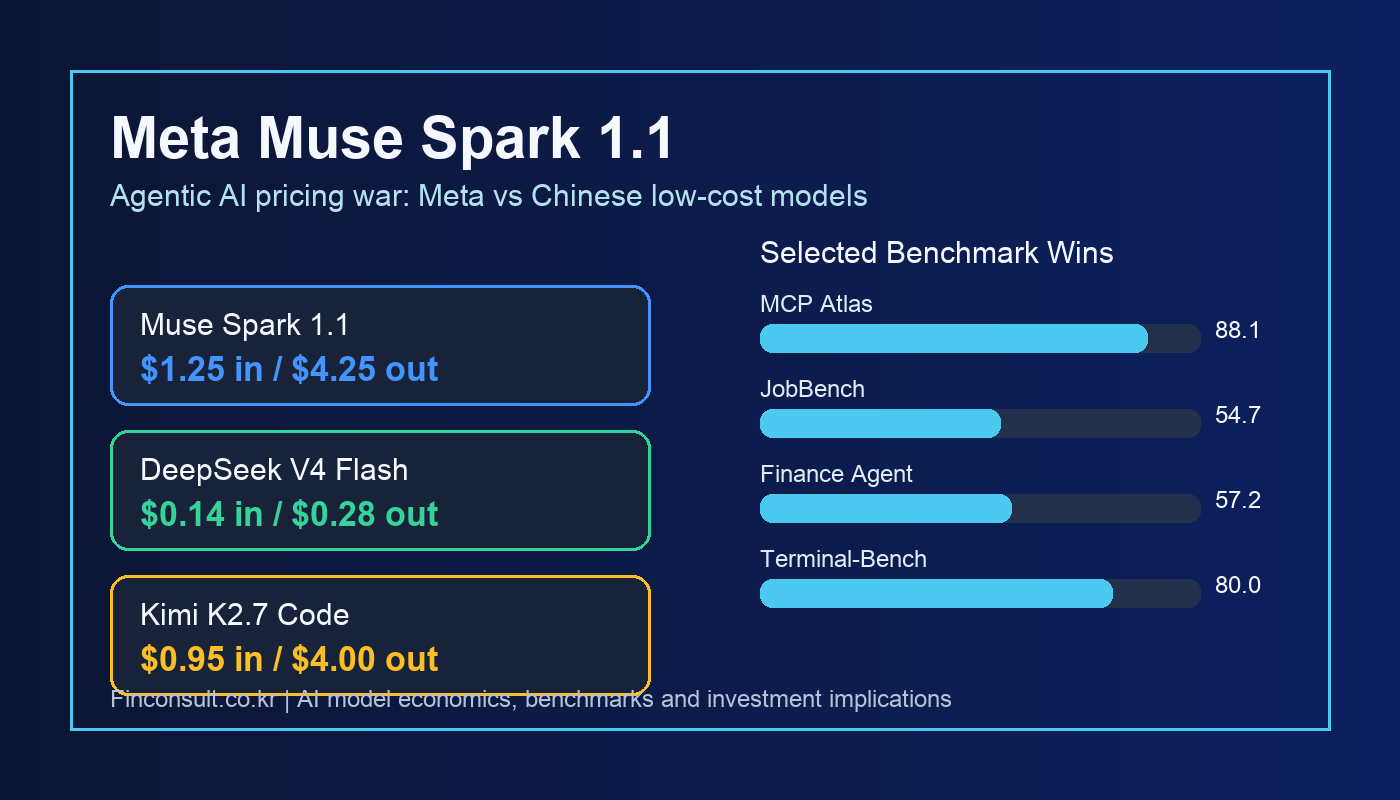
The most important part of the Muse Spark 1.1 launch may be the price. TechCrunch, citing Reuters, says Meta will charge $1.25 per million input tokens and $4.25 per million output tokens, with $20 in free credits. That price is not “cheap” if the benchmark is DeepSeek V4 Flash. It is very cheap if the benchmark is a high-end Western agentic model that enterprises might compare with Claude, GPT, or Gemini.
| Model | Input / 1M tokens | Output / 1M tokens | Notes |
|---|---|---|---|
| Meta Muse Spark 1.1 | $1.25 | $4.25 | 1M context; public preview; Reuters/TechCrunch cited price |
| DeepSeek V4 Flash | $0.14 | $0.28 | Official DeepSeek API price; cache hit input $0.0028 |
| DeepSeek V4 Pro | $0.435 | $0.87 | Official DeepSeek API price; cache hit input $0.003625 |
| Kimi K2.7 Code | $0.95 | $4.00 | Official Kimi price; cache hit input $0.19 |
| Kimi K2.7 Code HighSpeed | $1.90 | $8.00 | Official Kimi price; cache hit input $0.38 |
The table shows the trap in saying simply that Meta is “cheap.” DeepSeek V4 Flash is dramatically cheaper: $0.14 per million input tokens and $0.28 per million output tokens, with an even lower cached-input price. Kimi K2.7 Code also sits close to Muse Spark 1.1, with an official standard price of $0.95 input and $4.00 output per million tokens. If the contest is a raw race to the lowest token price, Meta does not win.
But enterprise AI buying is not just a supermarket shelf comparison. Companies care about model capability, latency, reliability, legal comfort, data governance, region, support, logs, abuse monitoring, procurement approval, and whether the vendor will still be around in three years. Meta’s likely argument is: “We are not as cheap as DeepSeek, but we are a Western big-tech platform with a strong agent model, massive distribution, and enough infrastructure ambition to support enterprise workloads.” That is a different pitch.
A simple analogy helps. DeepSeek is the incredibly good street-food taco that costs $3. Muse Spark 1.1 is the $7 taco from a chain that can sign a national catering contract, provide invoices, meet compliance requirements, and deliver the same box to 500 offices. The street-food taco may taste better. The chain may still win the corporate account.
The Benchmark Chart: Agent Manager, Not Coding King
The benchmark picture is useful because it prevents the story from becoming too simple. Based on Meta evaluation figures summarized by Kingy.ai and OfficeChai, Muse Spark 1.1 looks strongest in agentic and tool-use workloads. It leads on MCP Atlas, JobBench, Finance Agent v2, and Humanity’s Last Exam with tools. It is competitive but not dominant on computer-use and coding-heavy benchmarks.
| Benchmark | Category | Muse Spark 1.1 | Best competing score | Apparent winner |
|---|---|---|---|---|
| MCP Atlas | Agent / tool use | 88.1 | 82.2 | Muse Spark 1.1 |
| JobBench | Professional tool use | 54.7 | 48.4 | Muse Spark 1.1 |
| Finance Agent v2 | Finance agent | 57.2 | 53.9 | Muse Spark 1.1 |
| Humanity's Last Exam with tools | Tool reasoning | 62.1 | 57.9 | Muse Spark 1.1 |
| Toolathlon-Verified | Personal tool use | 75.6 | 76.2 | Claude Opus 4.8 |
| OSWorld-Verified | Computer use | 80.8 | 83.4 | Claude Opus 4.8 |
| Terminal-Bench 2.1 | Coding terminal | 80.0 | 83.4 | GPT-5.5 |
| SWE-Bench Pro | Software engineering | 61.5 | 69.2 | Claude Opus 4.8 |
| DeepSWE 1.1 | Long-horizon coding | 53.3 | 67.0 | GPT-5.5 |
| CharXiv Reasoning | Chart reasoning | 88.4 | 89.9 | Claude Opus 4.8 |
This is not a clean “Meta beats everyone” story. On Terminal-Bench 2.1, GPT-5.5 leads with 83.4 versus Muse Spark 1.1 at 80.0. On SWE-Bench Pro, Claude Opus 4.8 leads with 69.2 versus Spark at 61.5. On DeepSWE 1.1, GPT-5.5 leads with 67.0, while Muse Spark 1.1 scores 53.3. If your only question is “Which model is best at pure coding benchmarks?”, Muse Spark 1.1 is not the uncontested answer.
But the more interesting question is “Which model can finish a messy business task at a reasonable cost?” Real enterprise automation is not one benchmark. It involves reading files, opening browsers, calling APIs, asking for missing information, handling errors, editing code, checking screenshots, and trying again when something breaks. That is why Meta’s emphasis on agentic performance, tool use, and computer use matters. Muse Spark 1.1 is being positioned as a workflow model: less of a genius poet, more of a tireless operator.
The China Model War: DeepSeek Changed the Price Memory of the Market
Chinese low-cost AI models are the shadow competitor in this launch. DeepSeek’s official pricing is a reminder that the industry’s cost structure has changed. A powerful model at $0.14 input and $0.28 output per million tokens creates a new reference point. Even if enterprises do not use DeepSeek directly for sensitive workloads, procurement teams now know that capable models can be much cheaper than the old frontier-model price stack suggested.
Kimi adds another angle. Kimi K2.7 Code is a coding-focused model with a 262,144-token context window, official pricing of $0.95 input and $4.00 output per million tokens, and a higher-speed option at $1.90 input and $8.00 output. Alibaba’s Qwen ecosystem adds cloud distribution, multiple model tiers, and China’s aggressive platform economics. Together, these models create a new buyer psychology: “Why should I pay premium Western prices unless the model clearly saves more money, reduces risk, or integrates better?”
That question is brutal for AI companies. It compresses API margins. It forces premium labs to prove reliability, enterprise support, safety, and integration value. It also changes the architecture of AI spending. If model tokens become cheaper, customers spend more of their budget on workflow tools, orchestration layers, security, observability, and domain data pipelines. In other words, the model becomes less like a rare jewel and more like compute electricity: still important, but increasingly price-sensitive.
Why Meta Can Fight This Battle Differently
Meta is not a traditional cloud provider. Google can sell Gemini through Google Cloud. Amazon can bundle models into AWS Bedrock. Microsoft can package OpenAI, Azure, GitHub, and Copilot into one enterprise relationship. Meta’s core business is advertising and social platforms. That makes its AI strategy unusual. Muse Spark 1.1 is not only about selling tokens. It is about reducing internal dependence on rivals, strengthening Meta AI across consumer surfaces, and building a developer ecosystem around Meta’s own model infrastructure.
Meta also has distribution that most AI labs can only dream about. Facebook, Instagram, WhatsApp, Messenger, Threads, Meta AI, and AI glasses are not small surfaces. If Muse Spark improves the assistant inside those products, the model can be deployed at huge scale even before external API revenue becomes meaningful. This gives Meta a different return path from a pure AI startup. The model can improve ads, moderation, customer support, creator tools, business messaging, and commerce workflows.
Then there is hardware. TechCrunch, citing Reuters, reported that Meta’s latest AI-specific chips are on track to enter production in September, with Broadcom involved in design and TSMC manufacturing them. Meta has been developing chips under the MTIA program since 2023. It still needs Nvidia and AMD, but custom silicon can reduce cost pressure for internal workloads. If you want to price an AI model aggressively, owning more of the infrastructure stack helps.
Investment Implications: Good Signal, Expensive Game
For Meta shareholders, Muse Spark 1.1 is a positive strategic signal. It suggests Meta is closing some of the gap with rivals in agentic AI, reducing reliance on external models, and creating a path toward developer-facing AI revenue. It also gives the company a stronger story around its enormous AI capex. Instead of saying “trust us, the models are coming,” Meta can now point to a developer API, benchmark gains, and specific agentic use cases.
The risk is that this is still an expensive game. Meta’s AI spending is enormous. The company has guided to heavy capital expenditure, and TechCrunch reported expectations of $125 billion to $145 billion in capex this year, much of it tied to AI. Aggressive pricing helps win developers, but it also limits near-term monetization. If China-linked models keep lowering the market price, Meta may need to accept lower token margins for longer.
There is also a product risk. Agentic AI benchmarks are not fully standardized. Tool-use results can change depending on prompts, scaffolds, retry rules, browser environments, and integration layers. A model that looks strong in one benchmark can disappoint in a messy enterprise deployment. The market will need independent tests, real customer adoption, and usage data before treating Muse Spark 1.1 as a proven profit engine.
Who Wins and Who Loses?
The obvious winners are developers and enterprise buyers. More competition means lower prices, better models, and faster product cycles. If Meta, OpenAI, Anthropic, Google, DeepSeek, Kimi, and Qwen all fight for agentic workflows, customers get a much better menu. The less obvious winners are orchestration platforms, observability tools, security layers, and data-integration companies. As model prices fall, the value shifts toward tools that help companies use models safely and repeatedly.
The pressure lands on premium model vendors that cannot justify high prices with visible productivity gains. It also lands on smaller AI labs without distribution, cloud relationships, or deep capital. The frontier model business is becoming a game for companies that can either run very cheaply, sell very high-value enterprise outcomes, or bundle models into a larger platform. Everyone stuck in the middle will feel squeezed.
Conclusion: Muse Spark 1.1 Is a Pricing Signal as Much as a Model Launch
Meta Muse Spark 1.1 is important because it shows Meta moving from open-source influence and consumer AI features into the paid agentic API market. The model is not clearly the best pure coding system in every benchmark, but it looks strong in tool use, computer use, finance agents, and professional workflow tasks. That is exactly where enterprise AI budgets are moving.
The larger story is pricing. Chinese low-cost models have changed the market’s memory of what AI should cost. DeepSeek, Kimi, and Qwen make it harder for Western labs to charge premium prices unless they can prove better trust, integration, support, or completion rates. Meta’s answer is to price Muse Spark 1.1 aggressively while leaning on its distribution, infrastructure spending, advertising cash flow, and consumer product reach. The AI race is no longer just about who has the smartest model. It is about who can complete the most valuable work at the lowest reliable cost. Muse Spark 1.1 is Meta’s first serious swing at that new game.
Related Topics
- Samsung PM1763 PCIe 6.0 Enterprise SSD: The Storage Layer Behind the Next AI Wave
- The reasons why AMD’s MI300X has a competitive advantage over Nvidia’s H100
- Llama 3 and the open-source AI ecosystem
Sources: TechCrunch, Reuters as cited by TechCrunch, Financial Times, Kingy.ai summary of Meta evaluation report, OfficeChai benchmark summary, DeepSeek API pricing page, Kimi official pricing page, TechCrunch report on Meta AI chip plans.
Language versions:
한국어 원문 |
English version