
Summary
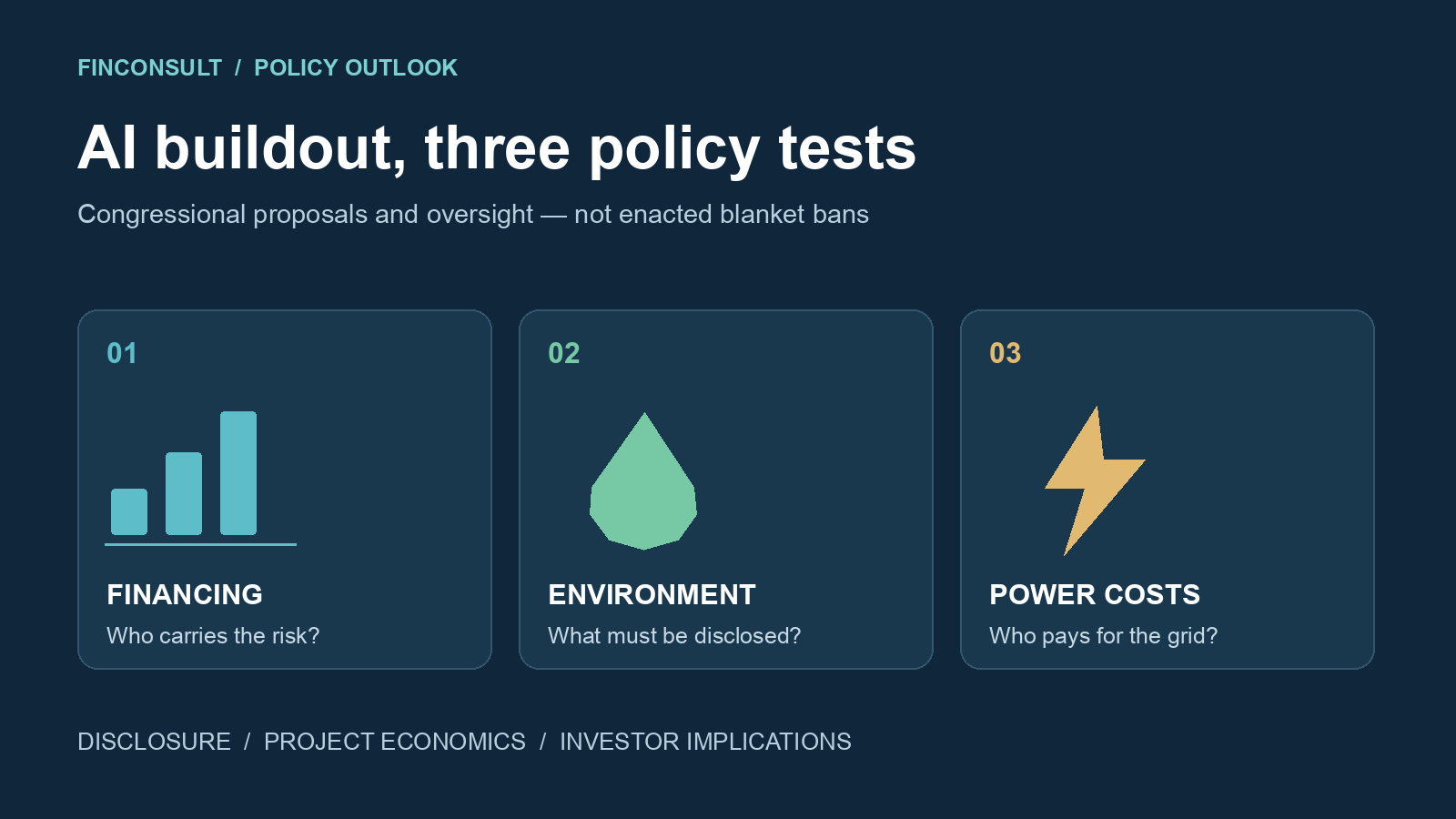
- The clearest Democratic congressional priorities are financial-risk disclosure, environmental transparency, and making data centers pay their own electricity-system costs—not an immediately achievable nationwide AI ban.
- Hearings and investigations are more likely than sweeping new laws. Trump retains the veto, while a new congressional majority does not take office until January 2027.
- The investment risk is a higher cost of financing, powering, and permitting individual projects. Strong balance sheets and credible power plans could matter more than headline AI spending.
Introduction
Democrats’ AI regulation agenda is becoming a fight over three ordinary questions: who lent the money, who supplies the power, and who pays when something goes wrong?
That is a more useful way to assess Washington’s next moves than treating every Democratic proposal as a plan to stop artificial intelligence. The most actionable agenda is directed at the financial and physical infrastructure behind AI: debt, data centers, electricity networks, water, and public subsidies.
The political setting is changing. Reuters reported on November 4 that Democrats were winning control of both congressional chambers. That reporting informs this outlook; it is not a claim that every race has been certified. The outgoing Republican-led Congress remains in place until the new Congress convenes on January 3, 2027. [1]
Republicans in Congress therefore need to be considered in two roles: the current majority during the lame-duck session and the prospective opposition in the next Congress. Trump remains president in either case. Changing committee leadership does not transfer control of executive agencies to Democrats.
Why it matters
An AI project can remain commercially attractive and still become less profitable if its financing costs rise, its connection to the grid takes longer, or its owner must absorb infrastructure costs previously shared with other customers. Investors do not need a federal construction ban to face a material change in project economics.
This article selects the three policies with the strongest combination of introduced legislative text, repeated oversight activity, and a practical congressional route. “Most definite” means best-supported policy direction—not guaranteed enactment or a unified Democratic platform. The forecast horizon is the opening year of the next Congress, principally 2027.
Main Analysis: Democrats’ AI Regulation Agenda in Three Policies
1. Make AI financing—and the financial system’s exposure to it—visible
The documentary foundation. Senators Elizabeth Warren and Richard Blumenthal’s AI Bubble Transparency Act, S.4743, was introduced on June 10, 2026. Its central mechanism is compulsory information gathering, not a prohibition on technology companies borrowing money. [2]
The bill would require the Office of Financial Research to order financial companies to report AI-linked debt and equity exposures within 180 days of enactment. Requested credit information includes counterparties, collateral, maturity, interest rates, and off-balance-sheet liabilities. It permits exemptions for smaller firms or exposures. An FSOC assessment and recommendations would follow within a year. These clocks start after enactment, not introduction. [2]
The Senate Banking Democrats’ accompanying explanation identifies banks, insurers, private-credit funds, and other financial institutions as relevant sources of exposure information. This is important: the policy reaches beyond the technology company issuing an ordinary corporate bond to the network financing the buildout. [3]
Financial Times reporting in April described a Meta-backed campus seeking $3 billion of loans that would finance both computing facilities and on-site power assets. WSJ’s November 1 commentary examined supplier-linked financing. These are reasons to ask how risks are connected; neither transaction structure, by itself, establishes fraud or insolvency. [4][5]
The Federal Reserve offers a useful counterweight to political rhetoric. In May, Governor Lisa Cook identified rising AI-infrastructure leverage as a potential vulnerability, while noting that even ambitious debt projections would be unlikely to recreate pre-financial-crisis peak leverage. Her speech presents her own views, not a new regulatory rule. [6]
What Democrats are likely to do. A committee-led inquiry into lenders, private-credit managers, financing vehicles, guarantees, and related-party transactions is more plausible than an immediate statutory cap on AI borrowing. Hearings could ask whether several nominally separate exposures ultimately depend on the same tenant or model developer.
This also clarifies “Big Tech financial activities.” The strongest evidence here concerns financing AI investment. It does not establish that Congress is about to prohibit Big Tech from providing payments, lending, or other financial services. AI-driven credit decisions and financial-consumer protection are a separate policy track; Maxine Waters’ July financial-services AI request for information shows that work is continuing, but it is not itself a new law. [7]
Trump and Republican response. Our forecast is resistance to AI-specific borrowing restrictions and arguments that existing financial supervision should remain technology-neutral. A narrower exposure study could be easier to negotiate if it protects confidential information and does not automatically impose new capital requirements.
The sharper political confrontation would involve public support. Waters and Greg Casar introduced an October 29 resolution opposing corporate AI-bubble bailouts. It is a statement of policy, not an enacted ban on emergency assistance. [8] Democrats could use hearings and spending negotiations to challenge proposed guarantees or subsidies, but those tools do not automatically cancel existing statutory authorities.
Investment consequence. Greater transparency could distinguish robust borrowers from projects dependent on repeated refinancing. The vulnerable point is not necessarily the largest technology company: it may be a highly leveraged developer, a concentrated lender, or a supplier financing its own customer. Our inference is that disclosure could widen differences in financing costs rather than depress every AI company equally.
Assessment: High confidence in renewed oversight; moderate confidence in a push for mandatory disclosure; lower confidence in enactment of a broad financing restriction under Trump.
2. Turn data-center environmental claims into comparable public information
The documentary foundation. The Artificial Intelligence Environmental Impacts Act of 2026 appears as S.4727 and H.R.9183. The Senate bill was introduced June 9; the House version June 8. They provide a concrete template for EPA studies, NIST measurement work, and environmental reporting—not a nationwide construction moratorium. [9][10]
The House text covers AI facilities with rated capacity or peak load exceeding 50 megawatts. It would require annual reporting of energy and water use and other impacts, with public disclosure subject to protections for qualifying confidential commercial information. Noncompliance could lead to corrective action and penalties. This is a reporting-and-accountability architecture, not a new project-by-project environmental approval test. [10]
A narrower bipartisan route also exists. Senators Lisa Blunt Rochester, a Democrat, and John Curtis, a Republican, introduced the Data Center Transparency Act of 2026, S.5640, on September 30. It proposes public EPA reporting on water and emissions impacts and EIA reporting on electricity use. Its agency-reporting model should not be confused with the broader annual operator-reporting system above. [11]
The case for better measurement is not confined to party offices. GAO’s April 2025 assessment found limited disclosure and uncertainty about the portion of data-center electricity attributable to generative AI. Total data-center demand and AI-only demand are not interchangeable statistics. [12]
What Democrats are likely to do. Expect demands for consistent facility-level information, public scrutiny of environmental claims, and questions about confidentiality agreements with local governments. WSJ’s September reporting on Jamie Raskin’s inquiries is corroborated by the House Judiciary Democrats’ own announcement. The letters are investigative demands, not proof that the companies broke the law. [13][14]
There is also an introduced bipartisan No Secrets for Data Centers Act, H.R.10570. Its purpose is to limit specified secrecy clauses involving public officials and related government incentives; it should not be described as outlawing all commercial nondisclosure agreements. [15]
Our forecast is a transparency-first strategy. Standardized data could subsequently support stronger local permitting conditions, but that later consequence must be distinguished from what the reporting bills actually require.
Trump and Republican response. The administration’s existing direction is faster construction. Executive Order 14318, signed July 23, 2025, directs federal permitting acceleration and contemplates financial support for qualifying projects within available legal authority. [16]
The likely compromise is a limited disclosure regime with confidentiality safeguards and an explicit effort to avoid delaying permits. Republican participation in S.5640 and H.R.10570 demonstrates room for that negotiation. It does not imply Republican endorsement of broad carbon limits or a new federal permitting veto.
Investment consequence. Better reporting could expose differences between projects relying on scarce local water, high-emission on-site generation, or credible lower-impact designs. Our inference is that efficient cooling, verifiable water planning, and less contentious sites gain relative value. Operators with stronger compliance systems may also absorb fixed reporting costs more easily than small developers—a potential unintended advantage for incumbents.
Assessment: High confidence in transparency pressure; moderate confidence in a narrower bipartisan measure; lower confidence in a comprehensive new federal environmental approval regime.
3. Require data centers to carry the electricity-system costs they create
The documentary foundation. Chris Van Hollen’s Power for the People Act of 2026, S.3682, was introduced January 15. It would establish data-center load queues and require allocation of incremental local transmission-upgrade costs to the relevant data centers. Its retail-rate provisions require states to consider dedicated rate classes and protections; they do not simply impose one federal retail tariff nationwide. [17]
Van Hollen’s public explanation frames the proposal as consumer protection and grid reliability. That framing matters politically: it focuses on household bills rather than requiring voters to take a position on frontier-model safety. [18]
The resource issue is substantial, but forecasts must be labeled correctly. Berkeley Lab’s June 2026 update estimates all U.S. data centers could consume 11.8% of U.S. electricity in 2030 in its reference case, with a 9.5%–15.3% scenario range. These are modeled outcomes—not current consumption, a certainty, or an estimate for AI alone. [19]
What Democrats are likely to do. We expect pressure for contracts that make large customers pay for the capacity and infrastructure reserved for them, including when utilization disappoints. The central question is who bears the stranded cost if a planned campus is delayed, downsized, or abandoned.
Tax incentives belong within this same “who pays?” debate, not as a fourth central policy. Mark Warner’s S.5054, introduced July 21, proposes restricting bonus depreciation for covered AI-data-center property, with green-building exceptions. Republican Josh Hawley’s S.5418 targets Opportunity Zone tax treatment instead. These are different tax instruments; neither is a blanket ban on data-center deductions. [20][21]
Our forecast is that disclosure of subsidies and project costs will advance further than a comprehensive reversal of tax incentives. A targeted restriction could attract a populist coalition, but disagreement over investment and local jobs remains substantial.
Trump and Republican response. It would be inaccurate to say Trump rejects the principle that technology companies should pay. His March 4 Ratepayer Protection Pledge calls for companies to fund additional generation, infrastructure upgrades, and power commitments. A presidential pledge is not equivalent to a generally applicable congressional cost-allocation statute; enforceability also depends on the contracts and regulatory arrangements implementing commitments. [22]
The dispute is therefore over enforcement, scope, and the bargain attached to protection. The White House’s March AI legislative recommendations pair ratepayer protection with streamlined permitting and a national AI framework. The administration is likely to favor protection that enables construction rather than a package that can routinely delay it. [23]
Republicans are not unified deregulators here. Senator Jon Husted sought passage of a narrower Ratepayer Protection Act, while Van Hollen publicly opposed advancing it without stronger provisions. Their official statements reveal disagreement about the strength of protection, not an absence of concern on one side. [24][25]
Investment consequence. Our inference is a shift in bargaining power toward parties controlling deliverable electricity, rather than an automatic windfall for every utility. More grid investment is attractive only if costs are recoverable and customers remain creditworthy. Data-center tenants may face higher deposits, minimum payments, or infrastructure commitments; equipment suppliers benefit only when projects progress to funded orders.
Assessment: Highest relative prospect for a negotiated policy outcome among the three themes; lower confidence that the full Democratic package survives unchanged.
What Congress Can Change—and What It Cannot
A majority can set hearing agendas, seek records, develop legislation, and use committee investigative powers under applicable rules. It cannot, merely by holding a hearing, direct an independent regulator to adopt a rule or turn an allegation into a legal finding.
For ordinary Senate legislation, ending debate generally requires 60 votes under current rules. Overriding a presidential veto requires two-thirds of members voting in each chamber, assuming a quorum. Budget reconciliation can sometimes bypass the ordinary cloture hurdle, but its subject-matter constraints remain and it does not bypass the president. [26][27]
Unfinished bills normally expire at the end of a Congress and must be reintroduced. The 119th-Congress bill numbers discussed here are evidence of a policy blueprint, not assurances that identical text or numbering will govern the next Congress. Some measures could still move during the lame-duck session. None of the core introduced texts reviewed here is treated as enacted law in this article.
The base case is consequently more scrutiny, selective compromise, and uneven state-level implementation, rather than a single federal switch turning off AI investment. State utility commissions and local permitting authorities operate through their own legal processes. New governors and legislators may change those processes, but a campaign promise is not an effective prohibition. FT’s November 4 coverage of anti-data-center pledges underscores that separate state-level risk. [28]
Why not make a national AI pause one of the three central forecasts? Sanders and Casar have proposed an advanced-AI pause and a superintelligence ban, while Sanders and Alexandria Ocasio-Cortez have pursued a data-center moratorium. Those proposals matter as negotiating pressure, but they are not interchangeable measures or an agreed party platform. The documented coalitions for disclosure and household-cost protection provide a firmer near-term forecast than the broadest prohibitions. [29][30]
Investment Implications
The relevant distinction is increasingly between an announced project and a financeable, permitted, powered project.
Potential relative beneficiaries: cash-generative operators; developers with firm power arrangements and credible credit support; efficient cooling and water-management providers; and grid-equipment suppliers serving funded projects. These are conditional exposures, not blanket stock recommendations.
More exposed: speculative campuses, thinly capitalized developers, concentrated private-credit portfolios, and business plans relying on favorable subsidies or cheap shared grid infrastructure. Smaller entrants could face proportionately larger compliance burdens even if the rules target Big Tech politically.
For Korean semiconductor and equipment suppliers, Washington’s risk is partly about timing. Slower energization could defer customer acceptance and reorder deliveries without permanently eliminating underlying compute demand. Conversely, relocation and redesign could change which suppliers or equipment categories benefit. Those are commercial transmission channels to test in company disclosures, not established outcomes.
Investors should monitor five catalysts: new committee leadership and hearing calendars; reintroduced bills and Republican cosponsors; Treasury/OFR/FSOC information requests; state utility tariff and connection decisions; and changes in project financing, collateral, and delivery schedules. Broad anti-AI speeches matter less than a clause that changes who must fund a substation or guarantee a loan.
Conclusion
Democrats’ AI regulation agenda is most concrete where financial exposure, environmental information, and electricity costs intersect. The immediate question is not whether Washington can agree to stop AI, but whether companies will have to reveal and absorb more of the risks behind its expansion.
Trump is likely to resist an agenda framed as slowing American AI leadership, while accepting selected consumer protections that support construction. Congressional Republicans may oppose broad regulatory machinery yet cooperate on bills about household costs, secrecy, and subsidies.
The most defensible forecast is that oversight comes first, narrower rules have a better chance than sweeping controls, and the market begins repricing individual projects before Congress finishes writing a comprehensive law.
Related Topics
AI-infrastructure financing; private credit and financial stability; data-center power agreements; water-efficient cooling; Korean semiconductor supply chains.
Sources
- Reuters, post-election market and congressional outlook, November 4.
- GovInfo, S.4743 introduced text, June 10.
- Senate Banking Democrats, AI Bubble Transparency Act explanation, June 11.
- FT, Meta-backed data-center financing, April 3.
- WSJ, supplier-linked AI financing commentary, November 1.
- Federal Reserve, Governor Cook’s AI speech, May 27.
- House Financial Services Democrats, AI request for information, July 7.
- House Financial Services Democrats, Waters–Casar bailout resolution, October 29.
- GovInfo, S.4727 introduced text, June 9.
- GovInfo, H.R.9183 introduced text, June 8.
- GovInfo, S.5640 introduced text, September 30.
- GAO, generative AI environmental and human effects, April 22, 2025.
- WSJ, data-center nondisclosure inquiries, September 30.
- House Judiciary Democrats, Raskin investigation, September 30.
- GovInfo, H.R.10570 introduced text, September 24.
- GovInfo, Executive Order 14318, July 23, 2025.
- GovInfo, S.3682 introduced text, January 15.
- Senator Van Hollen, Power for the People Act explanation, January 15.
- Berkeley Lab, U.S. Data Center Energy Usage Report: 2025 Update, published June 2026.
- GovInfo, S.5054 introduced text, July 21.
- Senator Hawley, Opportunity Zone tax proposal, September 17.
- White House, Ratepayer Protection Pledge, March 4.
- White House, March 2026 AI legislative recommendations.
- Senator Husted, narrower ratepayer legislation, September 17.
- Senator Van Hollen, objection to advancing the Ratepayer Protection Act, September 30.
- U.S. Senate, filibusters and cloture.
- CRS, veto override procedure, January 5, 2026 version.
- FT, Democratic governors and data-center pledges, November 4.
- Senator Sanders, Sanders–Casar advanced-AI legislation, September 23.
- AP, Sanders–Ocasio-Cortez data-center moratorium proposal, March 25.