
Summary
- Chinese mature-node foundry pricing has recovered from the discounting cycle: SMIC’s utilization reached 93.7% in the second quarter of 2026, while an estimated revenue-per-standardized-wafer proxy rose about 13% year on year.
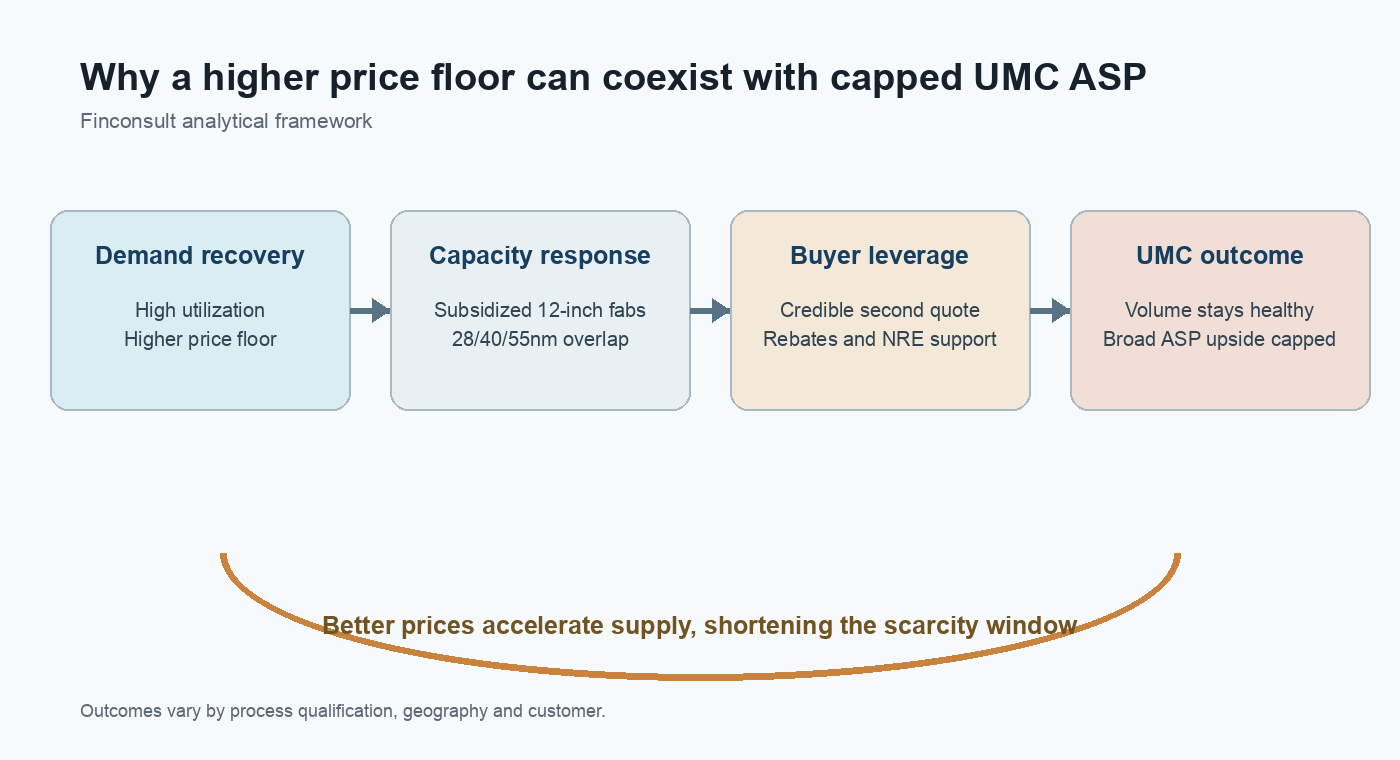
- The recovery is not a lasting scarcity signal. Chinese foundries are still adding subsidized 12-inch capacity at 28nm and nearby nodes, so better prices invite new supply faster than they did in earlier cycles.
- For UMC and peers, that means healthy volume and factory absorption but a ceiling on broad ASP gains. Specialty processes can still command premiums; commodity 28/40/55nm products remain exposed to credible Chinese alternative quotes.
Introduction
China’s mature-node foundries have stopped looking distressed. Demand is filling fabs, utilization is high and selected wafer prices have risen from their lows. Yet the same figures that confirm a recovery also explain why United Microelectronics Corp. is unlikely to enjoy a long, broad pricing supercycle.
The central tension is simple: the price floor has risen, but the scarcity period is getting shorter. SMIC, Hua Hong Semiconductor, Nexchip and regional projects continue to add 12-inch capacity for 28-nanometre and adjacent processes. State support and localization goals lower the financial hurdle for those projects. When demand improves, supply can respond before Taiwanese or U.S. rivals secure several years of large price increases.
This distinction matters because “mature node” is not one market. A 28nm automotive microcontroller qualified for a non-China supply chain is not interchangeable with a consumer display driver. UMC can defend pricing in differentiated processes, but Chinese quotations still influence negotiations for standardized products—even when the customer stays with UMC.
Analysis
SMIC shows a real recovery, not another price collapse
SMIC’s official second-quarter 2026 disclosure reported monthly capacity of 1.097 million eight-inch-equivalent wafers, up 10.6% from 991,250 a year earlier. Shipments rose 20.1% to 2.869 million wafers, utilization reached 93.7%, and revenue increased 36.1% to $3.006 billion. China supplied 90.2% of revenue, up from 84.1%, while quarterly capital spending was $1.836 billion.
Using disclosed wafer revenue and standardized shipments, Finconsult estimates wafer revenue per eight-inch-equivalent wafer rose from roughly $875 to $991, or about 13%. This is not a disclosed 28nm ASP. It mixes wafer sizes, process nodes, currencies and product mix. It is useful only as a directional proxy. Even with that caveat, it contradicts the idea that Chinese foundry pricing is still collapsing.
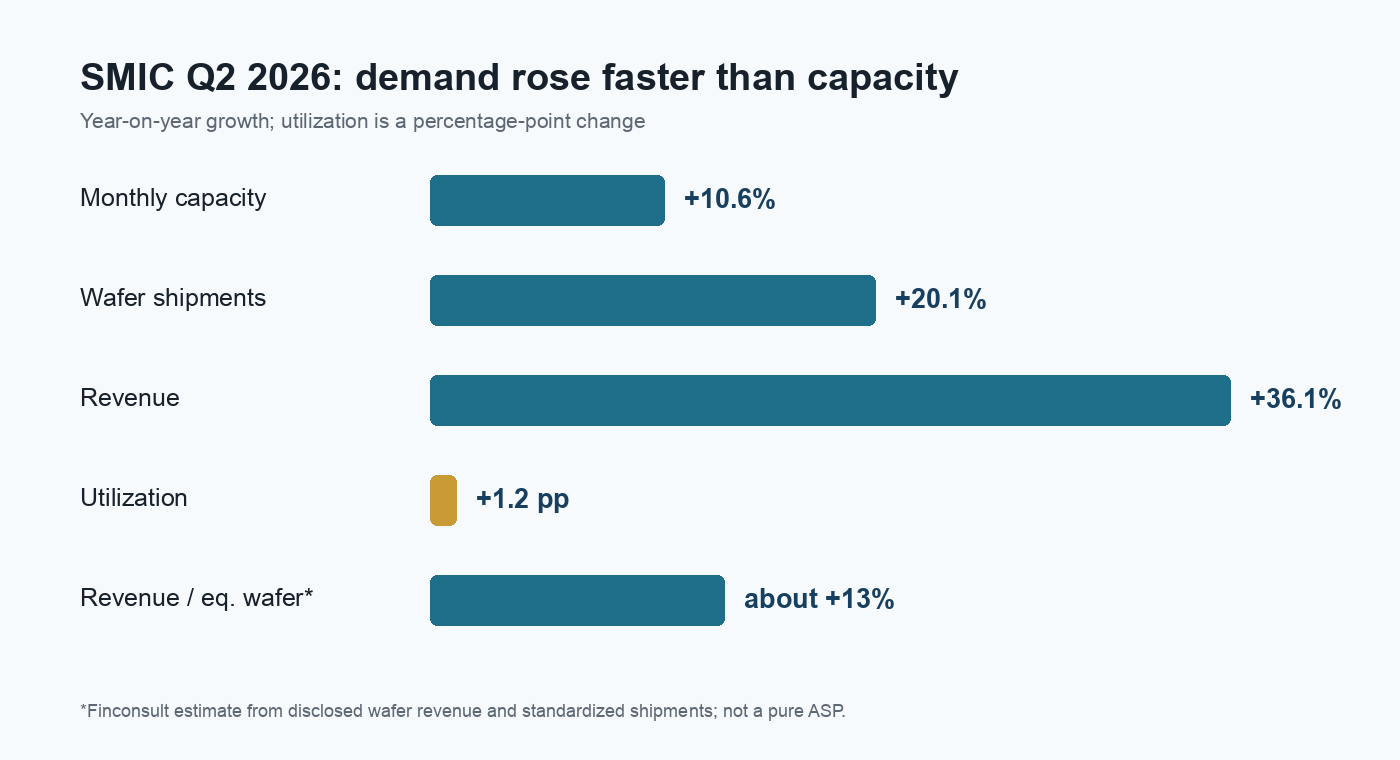
The more important number may be capacity. SMIC expanded standardized capacity by more than 10% while operating near 94% utilization. Its Q2 earnings release and 2026 interim report therefore describe both a strong market and a highly elastic supply base. Higher pricing does not simply fall to the bottom line; it helps justify another round of equipment and fab spending.
New 12-inch capacity sits in UMC’s competitive lane
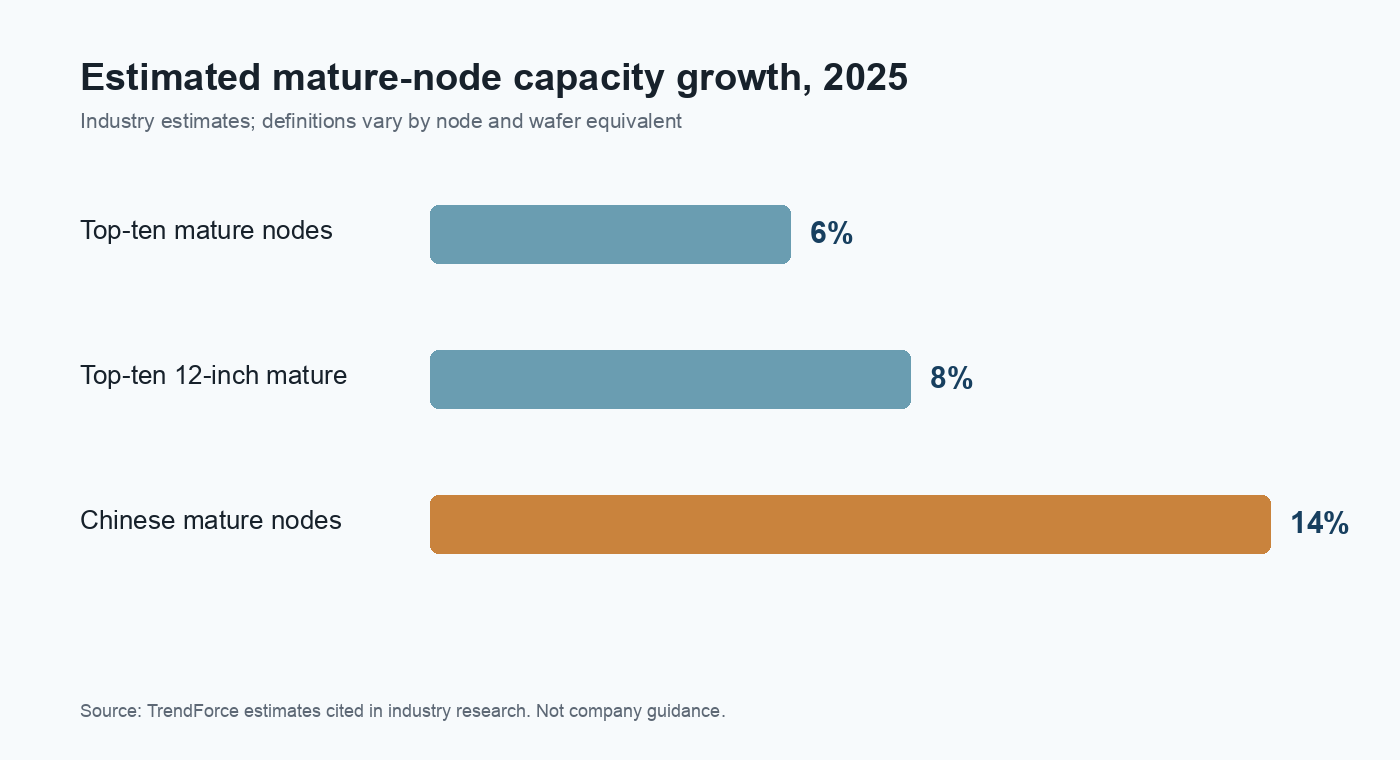
Industry estimates make the overlap clearer. TrendForce foundry research estimated that top-ten mature-node capacity would grow about 6% in 2025, their 12-inch mature capacity about 8%, and Chinese mature-node capacity roughly 14%. It also expected China to approach one-third of global mature-process capacity. These are third-party estimates, not company guidance, and definitions can vary by wafer equivalent and node cut-off.
Hua Hong has been ramping 12-inch output in Wuxi, while industry reporting places Nexchip’s Phase IV investment at RMB35.5 billion, or about $5 billion, with a focus on mature 12-inch production. The relevant products include display drivers, image sensors, power-management ICs, microcontrollers and consumer logic. Readers should treat project budgets, timing and ultimate wafer output as estimates until the companies disclose audited capacity and ramp data. Hua Hong’s financial-information page and HKEX listing filings are the primary places to check updates.
Qualification and yield ramps still take time. Nor is every wafer portable across foundries. But customers negotiate against expected alternatives, not only wafers available today. A credible second source can restrain UMC’s quotation before the Chinese fab wins meaningful share.
Price increases restore the floor, not monopoly economics
Industry reports said SMIC raised selected mature-node prices by around 10% in late 2025, with Hua Hong and Nexchip following on some products in 2026. Those increases are evidence that the market tightened. They also reveal how far prices had previously been discounted.
A 10% rise from a depressed Chinese base can leave the quote below UMC’s. Competition also appears through mask charges, non-recurring engineering support, rebates, minimum-volume commitments and bundled services. The headline wafer price is only one part of the effective contract.
Suppose UMC quotes $3,000 per wafer and a qualified Chinese fab offers an economically comparable product for $2,700 plus cheaper engineering support. A customer may stay with UMC for yield, automotive qualification or geopolitical security, but use the alternative to negotiate $2,850 to $2,900. UMC keeps the order and utilization remains high; its blended ASP rises only modestly.
UMC’s own numbers fit a volume-led recovery
UMC’s Q3 2026 SEC filing showed revenue up 8.0% sequentially and wafer shipments up 7.3%. That implies only about 0.7% improvement in revenue per wafer, including mix and currency. Utilization nevertheless climbed from 85% to 92%, and gross margin rose from 32.5% to 34.0% as higher throughput absorbed fixed costs.
The pattern was similar in the Q2 filing: revenue gained 12.6%, shipments 10.6%, and the revenue-per-wafer proxy roughly 1.8%. UMC’s 22/28nm share was 35% in Q3, while 22nm itself reached a record 18.3%. Strong specialty demand coexisted with more lower-value eight-inch volume. UMC’s quarterly-results archive provides the company presentations and calls behind those figures.
| Signal | Disclosure or estimate | Pricing message |
|---|---|---|
| SMIC utilization: 93.7% | Company disclosure, Q2 2026 | Demand is strong; current pricing is not distressed. |
| SMIC capacity: +10.6% YoY | Company disclosure, standardized wafer basis | Supply keeps expanding despite high utilization. |
| China mature capacity: about +14% | TrendForce 2025 estimate | Chinese supply grows faster than the broader mature-node market. |
| UMC Q3 revenue/wafer proxy: about +0.7% QoQ | Finconsult calculation from company data | Recovery remains more volume-led than price-led. |
Implications
The winners will be foundries that sell more than generic geometry. Automotive qualification, embedded non-volatile memory, high-voltage and BCD processes, RF/SOI, silicon photonics and secure non-China capacity are harder to substitute. UMC and GlobalFoundries can still improve mix and margins there. This is why investors should follow specialty-process revenue, not only the phrase “28nm shortage.”
The vulnerable area is standardized 28/40/55nm logic and display-related output that can be dual-sourced. Here, Chinese expansion caps price increases even if UMC does not lose the wafer. Rising depreciation is the second risk: UMC has approved substantial new capacity spending, including Singapore and Tainan projects. If supply arrives before ASPs broaden, free cash flow and returns can lag revenue growth.
What would change the thesis? A stronger pricing cycle would require Chinese capacity growth to slow materially, selected price rises to stick for several quarters without rebates returning, and UMC’s revenue-per-wafer proxy to keep increasing after utilization is already above 90%.
Conclusion
Chinese mature-node foundries have repaired the price floor. High utilization and better revenue per standardized wafer show that the 2024–25 discounting cycle is no longer the whole story. But recovery is not the same as durable scarcity.
Subsidized 12-inch additions make supply more responsive, especially in 28nm and neighboring commodity processes. For UMC and peers, the likely outcome is firm volume, better fixed-cost absorption and selective specialty premiums—alongside a lower ceiling on broad ASP gains. The cycle is real. The supercycle is not yet proven.
Sources and Related Reading
- SMIC — 2026 financial results archive
- SMIC — second-quarter 2026 earnings release
- SMIC — 2026 interim report
- UMC — third-quarter 2026 results filed with the SEC
- UMC — second-quarter 2026 results filed with the SEC
- UMC — quarterly-results archive
- Hua Hong Semiconductor — financial information
- TrendForce — foundry research portal
- TrendForce — second-quarter 2026 top-ten foundry ranking
- SEMI — World Fab Forecast
- OECD — semiconductor policy and supply-chain research
- GlobalFoundries — financial disclosures
Related Finconsult analysis: Samsung SF2P and Exynos 2700; EMIB-T and foundry packaging competition; HBM4 and the AI memory wall.