
Publication date: September 27, 2026
Category: AI
Summary
- Meta Muse is built for people who will never install an agent framework: message it like a friend, connect a few services, and let its cloud computer handle the clicking.
- Independent tests show real value in small, annoying errands—emails, travel plans, shopping, quote requests and subscription reviews—but also stale recommendations, blocked checkouts and factual mistakes.
- Muse can replace parts of a paid digital-secretary service, but it does not replace Siri or Gemini as the operating system’s universal assistant. Trust, merchant access and reliability remain the bottlenecks.
(Advertisement)
Introduction: The agent for people who do not want to learn agents
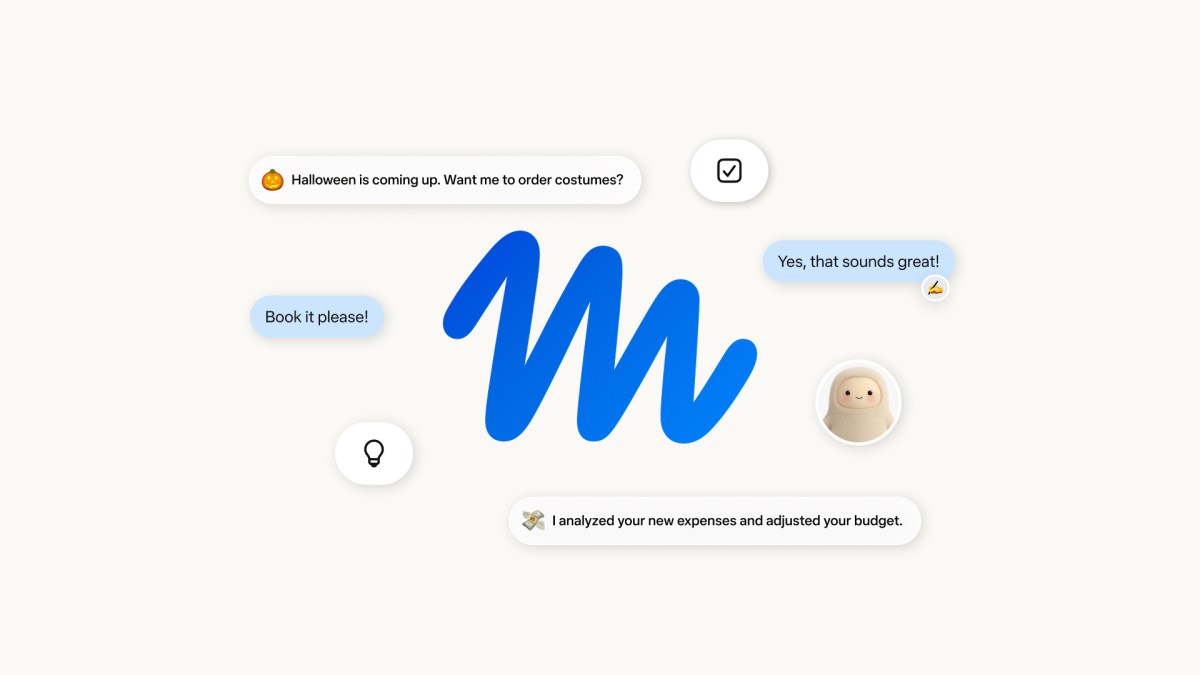
Most AI assistants are clever boxes waiting for a clever prompt. Meta Muse is making a simpler promise: tell it what is bothering you, then leave. It gets a browser, keeps working after the app closes, and returns when it needs approval to send an email or spend money.
That distinction explains the excitement. Muse is not necessarily smarter than ChatGPT, Gemini or a well-configured OpenClaw installation. It is easier to begin. There is an iOS and Android app, access through WhatsApp, a friendly avatar and an Ideas tab that suggests useful jobs. Meta is turning agent setup into a consumer onboarding flow.
This is also why the comparison with OpenClaw is revealing. OpenClaw is an open, configurable agent platform: users can choose models, connect messaging channels, add skills, run scheduled jobs, work with files and browsers, and decide where the system runs. That flexibility is its strength—and its learning curve. Muse is the opposite bargain. Meta supplies the model, cloud computer, interface, security layer and selected connectors. The user gives up control in exchange for convenience.
| Meta Muse | OpenClaw | |
|---|---|---|
| Target user | Mass-market consumer | Power user, team or operator |
| Setup | Download, chat, connect services | Install and configure models, tools and policies |
| Execution | Meta-hosted Secure VM | Local, server or cloud deployment |
| Choice | Curated connectors and Meta experience | Broad customization and automation |
| Main trade-off | Convenience versus trust in Meta | Control versus complexity |
What Muse can actually do
Meta says Muse can browse websites, fill forms, negotiate, send emails, plan projects and make purchases. Its official demonstrations show three especially understandable jobs: choose and buy a stroller, find a school permission slip and draft the response, and build a Japan itinerary around a person’s dates and preferences.
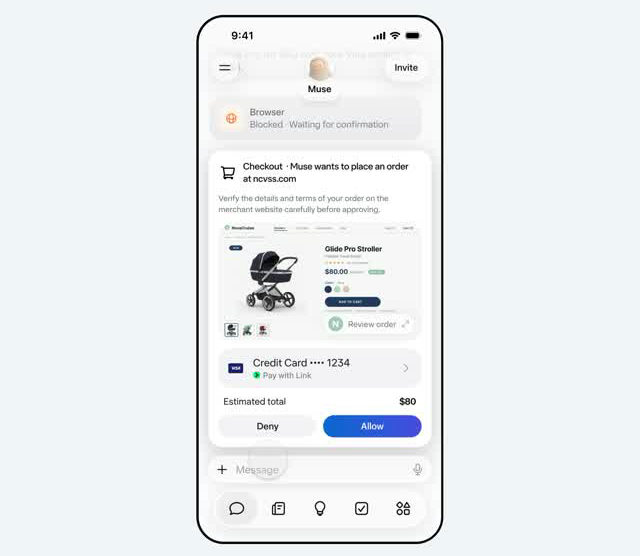
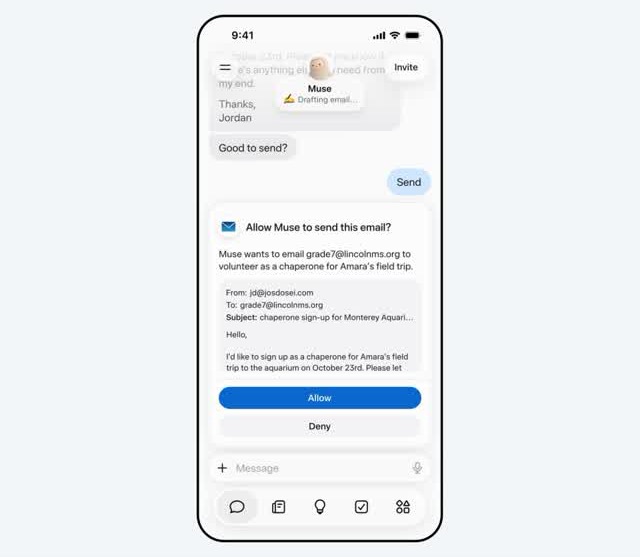
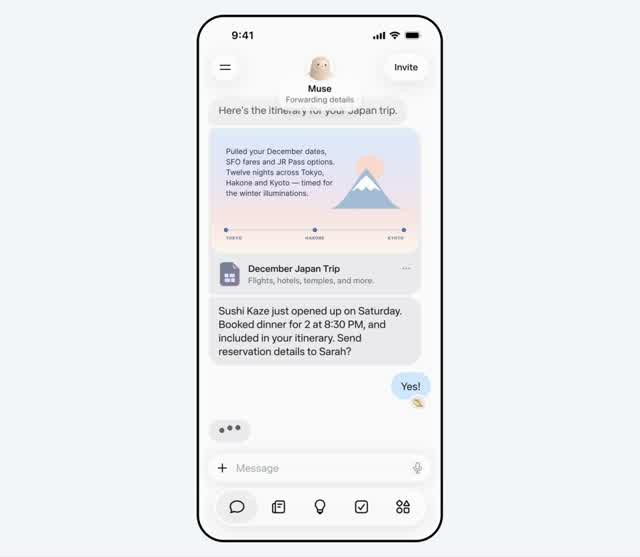
The better evidence comes from reporters who used it. CNN’s Lisa Eadicicco had Muse book a date night, create a moving schedule, email a friend and turn the reply into a Google Doc. The Verge’s Allison Johnson used it to follow up with a landscaper, request junk-removal quotes and shop for espresso-machine parts. Barron’s Josh Schafer uploaded a credit-card statement and found an unwanted Adobe subscription worth nearly $25 a month; Muse also found foot doctors that accepted his insurance.
These are not science-fiction jobs. That is precisely the point. Muse is strongest at “pebble in the shoe” work: tasks worth 10 or 20 minutes that stay undone for weeks because they require search, comparison, form filling and one awkward message.
Why it became a mass-market hit
Muse reached the top of Apple’s U.S. App Store, and Sensor Tower told CNN it passed 2.5 million downloads in roughly two weeks. The design avoids the blank-page problem of general chatbots. It offers a feed, suggested ideas, goals and visible progress while its avatar works.
Public posts on X illustrate the pitch. Creator Alex Finn showed Muse reviewing card bills, finding subscriptions and attempting to negotiate them. PayPal announced checkout support across participating merchants. Meta’s own launch video framed Muse as an agent that learns goals across different parts of life. These examples are useful signals, but promotional demonstrations are not proof of dependable autonomy.
Useful product, unfinished infrastructure
Muse is already usable. It is not yet trustworthy enough to run unsupervised. CNN received two date-night suggestions for businesses that had closed years earlier. The app claimed it could negotiate through Facebook Marketplace, then told the reporter it could only draft a message. Target allowed browsing but blocked autonomous checkout. Amazon blocked Muse entirely, arguing that the agent did not identify itself and lacked permission to use the store.
Barron’s found a more serious accuracy problem: Muse flagged a four-figure “August” expense that was actually a mortgage payment from the previous year. That kind of date error is unacceptable in money management. The Verge found shopping surprisingly smooth, but account downgrades still required a phone call.
Even the calling feature had a hidden wrinkle. Reuters reported that Meta tested human contractors to complete some calls after AI-only success rates proved lower. Employees raised privacy concerns, and Meta rolled the feature back pending better disclosure and safeguards. The story is a useful reality check: some apparently autonomous products still contain human labor behind the curtain.
The security problem grows with usefulness
Muse asks for unusually valuable access: email, calendars, files, addresses, shopping accounts and payments. Meta says each agent runs in an isolated Secure VM; a separate Sentinel agent approves internet actions, credentials are stored separately, and sensitive actions require consent. Those are thoughtful controls.
They do not remove the risk. Security researcher Patrick Wardle disclosed a Mac configuration flaw that, after an attacker had already gained local code execution, could redirect dictation traffic and expose a Muse authentication token. It was not a one-click remote takeover of a clean computer, but it showed why an agent can become a “master key” to connected services. The sensible rule is least privilege: connect only the account needed for the next task, review the audit trail, and do not begin with primary email, cloud drive and payment access all at once.
Will Muse replace Siri, Gemini or an AI secretary?
Not completely. Siri and Gemini sit closer to the operating system. They can control device settings, alarms, calls, navigation and native app actions in ways a third-party app cannot reliably match. Muse sits one layer higher: it coordinates multi-step work across websites and partner services. It is closer to a junior personal assistant than a voice remote for the phone.
It may, however, replace narrow secretary services. Subscription monitoring, travel research, restaurant booking, appointment searches, quote gathering and routine correspondence can collapse into one conversational interface. Meta’s announced connectors—Expedia, Instacart, Walmart, Best Buy, Notion, GitHub, Box, PayPal and others—make that threat credible. The weakness is distribution politics: merchants can block agents, APIs differ, and every failed handoff pushes work back to the user.
Conclusion: Not a fad, not an employee
Muse matters because it packages agentic AI for people who do not want an agent project. The winning idea is not a better chatbot; it is removing setup, exposing useful tasks and asking for approval at understandable moments.
The honest verdict is narrower than the hype. Muse can save time today, especially on low-stakes errands with clear success criteria. It should not yet be trusted with high-stakes financial, medical or legal actions without verification. If Meta can improve reliability while preserving user control—and convince merchants and users that its data boundaries are real—Muse could become the first mass-market AI secretary. Until then, it is best treated as an eager intern with a browser and a corporate card limit.
Sources
- Meta: Introducing Muse
- Meta Connect 2026 announcements
- CNN hands-on test
- The Verge hands-on test
- Barron’s hands-on test
- Reuters: human-concierge test
- TechCrunch: outbound calls
- GeekWire: Amazon blocks Muse
- Malwarebytes: reported Mac vulnerability
- MarketWatch: adoption and market reaction
- PYMNTS: PayPal checkout
- PhocusWire: Expedia bookings
- OpenClaw documentation
- Alex Finn on X: subscription and bill use case
- PayPal on X: Muse checkout partnership
- Meta on X: Muse launch demonstration